The best camping axes for backpacking balance cutting power with packable size, manageable weight, and dependable handling. A compact hatchet can help process kindling, clear small branches, and prepare a campsite without taking up too much room.
We selected 10 portable options ranging from simple chopping tools to multitaskers with saws, hammers, and fire-starting accessories. Use the guide below to match blade design, handle length, weight, and extra features to the way you camp.
Best 10 Camping Axes for Backpacking Picks for 2026
Lightweight Kindling Pick

- 1.4-pound lightweight design
- Low-friction forged-steel blade
- Shock-absorbing handle and lifetime warranty
Best For: Small to medium-sized kindling and firewood
Multi-Tool Trail Option
Camillus CAMTRAX 3-in-1 Hatchet
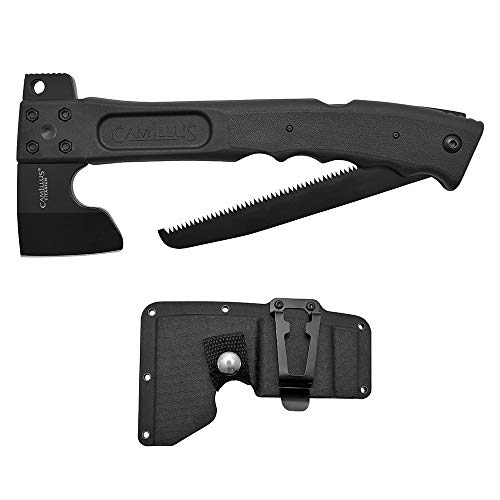
- Hatchet, folding saw, and hammer in one
- 7-inch lockback folding saw
- Includes sheath and reversible belt clip
Best For: Multi-function campsite utility
Heavy-Duty Campsite Workhorse
Coleman Steel-Handle Camping Axe

- Drop-forged alloy-steel head
- Non-slip rubber grip
- Stake-puller notch for campsite use
Best For: Wood splitting and tent-stake removal
Most Packable Mini Axe

- Compact 9.46-inch profile
- Lightweight 1.3-pound design
- Full-tang blade with removable nylon sheath
Best For: Lightweight hiking and compact campsite carry
American-Made Classic

- One-piece American steel construction
- Comfortable lacquered leather grip
- Includes ballistic nylon sheath
Best For: Durability-focused campers and outdoor users
Ultralight Pick

- 15% lighter compact X-series design
- Sharp forged steel blade with low-friction coating
- Bright handle and tent-stake striking end
Best For: Weight-conscious hikers and backpackers
Multi-Tool Value
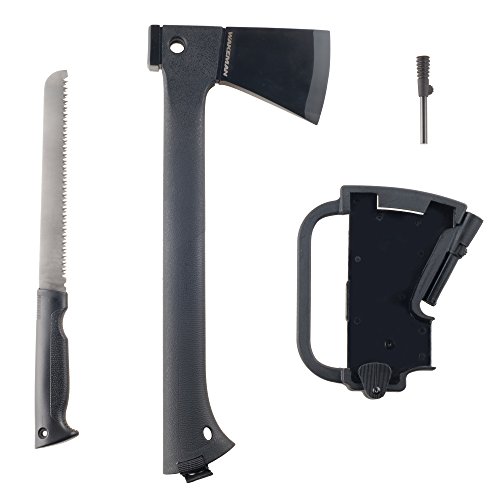
- Nested serrated wood saw
- Attached magnesium fire starter
- Sheath with belt clip
Best For: Campers wanting compact survival accessories
Compact Multitool Pick

- Compact 12-inch build for camp and trail tasks
- Five hex wrench slots add field utility
- Rubber grip and Oxford sheath support secure carry
Best For: Backpackers wanting a compact, versatile hatchet
Hand-Forged Splitting Pick
Purple Dragon 14.7-Inch Hatchet
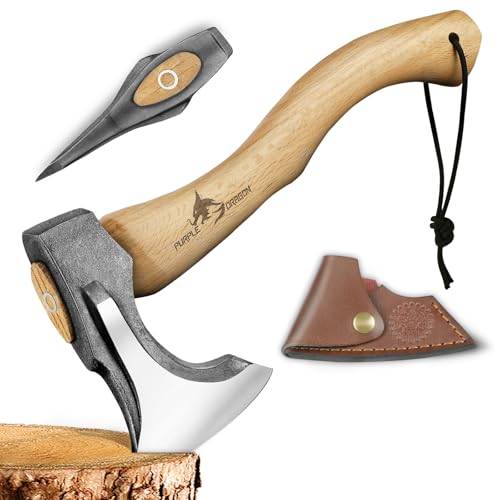
- Hand-forged high-carbon steel head
- Hickory S-curve handle absorbs shock
- Leather holster and edge lips support safe storage
Best For: Bushcraft campers prioritizing firewood splitting
Throwing and Trail Utility Pick
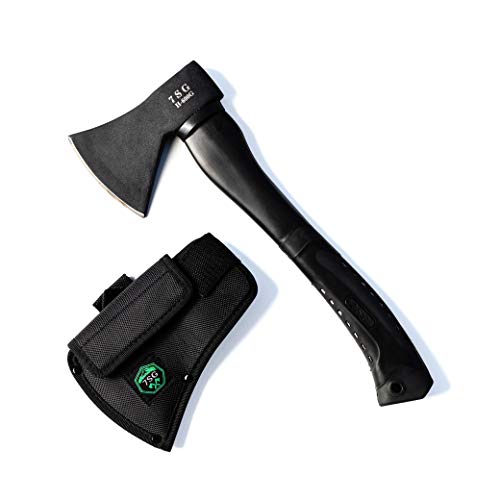
- Narrow profile supports throwing-axe use
- Fiberglass handle weighs 1.2 pounds
- Flat back works for driving stakes
Best For: Campers wanting a versatile lightweight hatchet
Lightweight Kindling Pick – Fiskars X7 14-Inch Hatchet
For camping axes for backpacking, the Fiskars X7 is a lightweight option focused on firewood prep, kindling splitting, and small branch removal. Its 14-inch format and 1.4-pound weight offer a useful balance of portability and chopping power.
Best For: Backpackers and campers preparing small to medium-sized kindling and firewood.
Pros:
- Lightweight 1.4-pound design with a balanced power-to-weight ratio.
- Low-friction forged-steel blade coating helps reduce sticking.
- Shock-absorbing FiberComp handle is designed to reduce hand fatigue.
- Includes a lifetime manufacturer limited warranty.
Cons:
- Its compact hatchet design is intended for small to medium-sized wood rather than large logs.
- At 14 inches, it may take more pack space than a mini hatchet.
The X7 is a practical choice when chopping performance matters but pack weight still needs attention. It is especially well suited to established campsites where kindling preparation is the main task.
Multi-Tool Trail Option – Camillus CAMTRAX 3-in-1 Hatchet
The Camillus CAMTRAX stands out among camping axes for backpacking by combining a hatchet, a folding lockback saw, and a hammer in one tool. Its 12-inch overall length adds versatility for campers who want several campsite functions without carrying separate tools.
Best For: Campers prioritizing multi-function utility for light wood processing and campsite tasks.
Pros:
- Combines a hatchet, 7-inch folding saw, and hammer.
- Scandi-ground titanium-bonded blade is designed for utility use.
- Includes a molded sheath and reversible belt clip.
- Glass-filled nylon handle supports left- and right-hand orientation.
Cons:
- At 1.9 pounds, it is heavier than the Fiskars and Gerber options listed here.
- Its multi-tool design may be less focused for users seeking a dedicated chopping axe.
The CAMTRAX makes the most sense when versatility outweighs minimal pack weight. The integrated saw and hammer can reduce the need for extra campsite tools.
Heavy-Duty Campsite Workhorse – Coleman Steel-Handle Camping Axe
The Coleman axe is a sturdy choice among camping axes for backpacking, with a drop-forged alloy-steel head, steel handle, and rubber grip. It is built for campsite wood splitting and also includes a notch for pulling tent stakes.
Best For: Campers who want a durable tool for wood splitting, hammering stakes, and general campsite work.
Pros:
- Drop-forged alloy-steel head and robust steel handle.
- Rubber grip provides a non-slip handhold.
- Stake-puller notch adds practical campsite versatility.
- 13-inch length keeps it relatively compact for a heavy-duty axe.
Cons:
- At 2 pounds, it is the heaviest option in this roundup.
- Its steel construction may be less comfortable to carry on longer backpacking trips.
The Coleman favors durability and campsite utility over minimum weight. It is a better fit for short approaches, vehicle-supported camping, or backpackers comfortable carrying a heavier tool.
Most Packable Mini Axe – Gerber Pack Hatchet
For hikers comparing camping axes for backpacking, the Gerber Pack Hatchet offers a compact 9.46-inch profile and 1.3-pound weight. Its full-tang steel blade, ergonomic rubber grip, and removable sheath make it convenient to carry for lighter campsite and outdoor tasks.
Best For: Backpackers and hikers who value compact carry and a sheath that can mount to a pack or belt.
Pros:
- Compact 9.46-inch overall length and 1.3-pound weight.
- 3.5-inch corrosion-resistant black oxide-coated steel blade.
- Full-tang construction and finger-grooved rubber grip.
- Removable nylon sheath supports pack or belt carry.
Cons:
- The 3.5-inch blade is smaller than those on the other full-size hatchets here.
- Its compact format is better suited to lighter cutting tasks than substantial wood splitting.
The Gerber is the strongest fit when portability is the deciding factor. It provides a small, carry-friendly package for hikers who need a basic hatchet without the bulk of a larger axe.
American-Made Classic – ESTWING Sportsman's Axe
For campers seeking dependable camping axes for backpacking, the ESTWING Sportsman’s Axe combines a compact 14-inch format with a forged, one-piece American steel construction. Its leather grip and included sheath make it practical for camp chores and carry.
Best For: Campers who prioritize durability, traditional materials, and versatile wood-processing performance.
Pros:
- Forged in one piece from solid American steel to eliminate casting and weld weak points.
- Leather grip is hand sanded and lacquered for comfort and control.
- Handles branches, small trees, firewood, kindling, and tent stake pulling.
- Ballistic nylon sheath protects the hand-sharpened 4-inch edge and includes a belt loop.
Cons:
- At 1.8 pounds, it is not the lightest option for weight-conscious backpacking.
- The leather handle may require more care than synthetic grips.
Its 14-inch length offers useful leverage without becoming a full-size axe, while the one-piece steel build favors long-term rugged use. Choose it when sturdy construction and a classic leather grip matter more than minimizing pack weight.
Ultralight Pick – Fiskars X13 Hiking Axe
The Fiskars X13 is a strong choice among camping axes for backpacking when packability and visibility are priorities. Its 13-inch design is 15% lighter than other compact X-series axes and includes features for chopping, carrying, and driving tent stakes.
Best For: Hikers and backpackers who want a lighter compact axe with a visible handle and included sheath.
Pros:
- 15% lighter than other compact X-series axes for easier stowaway and transport.
- Forged, double-hardened steel blade is designed to stay sharp longer.
- Bright orange FiberComp handle is easy to spot and absorbs shock.
- Striking end drives tent stakes, and the sheath includes a belt loop and locking mechanism.
Cons:
- Its 13-inch size is intended for compact tasks rather than heavy-duty chopping.
- The synthetic orange handle may appeal less to buyers seeking traditional wood or leather.
A low-friction coating supports smoother cuts and rust protection, while the insert-molded head is designed to reduce loosening and overstrike breakage. It is a practical lightweight option for campers balancing cutting utility with carry convenience.
Multi-Tool Value – Wakeman Camping Hand Axe
For shoppers comparing camping axes for backpacking, the Wakeman Camping Hand Axe adds a nested serrated saw and magnesium fire starter to a compact camp tool. Its 14-inch composite design is intended for small limbs, hiking, camping, and hunting.
Best For: Campers who value multiple basic survival tools in one carryable package.
Pros:
- Includes a serrated wood saw nested in the handle and a magnesium fire starter.
- Steel axe and saw blades are built for continuous outdoor use.
- Textured, ergonomic handle is designed for comfortable extended use.
- Nylon sheath includes a strap, snap closure, and belt clip.
Cons:
- At 2.3 pounds, it is the heaviest product in this comparison.
- Its composite-and-accessory design may be less suited to buyers seeking a simple dedicated axe.
- The manufacturer warranty is listed as unavailable.
This four-piece kit is useful when saw and fire-starting capability are as important as chopping. The added tools increase versatility, but the 2.3-pound weight is worth considering before carrying it on longer backpacking trips.
Compact Multitool Pick – Mossy Oak 12-Inch Camping Axe
For shoppers comparing camping axes for backpacking, the Mossy Oak 12-inch hatchet emphasizes compact carry and practical versatility. Its coated metal blade, textured rubber handle, wrench slots, and included sheath make it suited to routine camp and trail tasks.
Best For: Backpackers and campers who want a compact hatchet with built-in adjustment features.
Pros:
- Compact 12-inch size with a 6-inch-wide, 3/16-inch-thick blade.
- Includes five hex wrench slots and a secondary edge for bark or rope cutting.
- Textured rubber handle and reinforced head attachment promote secure handling.
- Oxford sheath includes belt loops and metal fasteners for transport.
Cons:
- The compact design is intended for lighter camp tasks rather than large-scale wood splitting.
- The supplied details do not specify the hatchet’s total weight.
This is a practical choice when packability and extra utility matter as much as chopping ability. The integrated wrench slots and carrying sheath give it an edge for minimalist outdoor kits.
Hand-Forged Splitting Pick – Purple Dragon 14.7-Inch Hatchet
Among camping axes for backpacking, the Purple Dragon stands out for campers who prioritize splitting performance. Its hand-forged carbon-manganese steel head, hickory S-curve handle, and leather holster create a traditional setup for processing firewood and handling bushcraft chores.
Best For: Bushcraft users and campers who need a wood-splitting-oriented axe with a wooden handle.
Pros:
- Hand-forged, hardened carbon-manganese steel blade rated at 56–60 HRC.
- Optimized splitting geometry is designed to improve efficiency through the wood.
- S-curve hickory handle provides a firm grip and shock-absorbing wood fibers.
- Leather sheath with snap closure and rubber cutting-edge protection aid storage.
Cons:
- At 1.1 kg, it is heavier than many ultralight backpacking hatchets.
- The wood handle may require more care than a synthetic handle.
- The supplied instructions recommend soaking the axe before use.
With its 14.7-inch length and splitting-wedge head, this model favors controlled firewood preparation over minimum pack weight. It makes the most sense for trips where chopping performance justifies carrying a heavier tool.
Throwing and Trail Utility Pick – 7SG Camping Hatchet
For buyers evaluating camping axes for backpacking, the 7SG hatchet combines a lightweight fiberglass handle with a narrow throwing-axe profile. Its 20-degree head angle, flat back, and ballistic nylon sheath make it a flexible option for chopping, clearing brush, and driving stakes.
Best For: Campers seeking a lightweight, multipurpose hatchet that can also support throwing-axe use.
Pros:
- Narrow profile is designed for throwing-axe performance.
- Fiberglass and rubber handle keeps the tool relatively lightweight at 1.2 pounds.
- Flat back can serve as a hammer for driving stakes.
- Ballistic nylon sheath has multiple openings and two hooking loops.
Cons:
- Its throwing-axe focus may be less relevant for backpackers seeking only wood-splitting performance.
- The listed details describe the blade length as 6 inches but do not provide overall dimensions.
- Its 1.3-pound head weight may still feel substantial for ultralight kits.
This hatchet is appealing when one tool needs to cover several camp jobs, including chopping, brush clearing, stake driving, and throwing practice. The sheath and lightweight handle also support easier packing than a full-size axe.
How We Picked These Camping Axes for Backpacking
We focused on compact hatchets and hand axes suited to car camping, base camps, and backpacking trips where space and weight matter. The selection covers established designs from Fiskars, Estwing, Gerber, Coleman, and Camillus, along with value-focused survival kits and smaller general-purpose axes.
Our comparison criteria include overall length, portability, blade and head construction, grip design, sheath or edge protection, intended camp tasks, and the usefulness of any included tools. A multitool can be convenient, but a dedicated hatchet may offer better balance and simpler maintenance.
Quick Comparison
- Best lightweight chopping options: Fiskars X7, Fiskars X13, and Gerber Pack Hatchet.
- Best traditional feel: Estwing Sportsman’s Axe.
- Best multitool approach: Camillus CAMTRAX and the Wakeman survival kit.
- Best budget-oriented choices: Coleman, Mossy Oak, Purple Dragon, and the compact survival-style hatchets.
Check each product’s current listed weight, dimensions, and included accessories before buying, since specifications can vary by seller or package version.
Key Buying Factors for Camping Axes for Backpacking
Weight and Packability
Every ounce becomes more noticeable on a long hike. A 12- to 14-inch hatchet is generally easier to carry and control than a full-size axe, but the lightest model is not automatically best if you regularly split dense hardwood.
Blade and Head Construction
Look for a securely mounted head and a blade suited to your work. Forged or hardened steel can provide useful durability, while a sharper, thinner edge typically handles kindling and small branches more efficiently. Never use a camping axe for wood that exceeds its intended capacity.
Handle, Grip, and Balance
A nonslip grip improves control in wet or cold conditions. Consider whether you prefer a lightweight composite handle, a traditional wood handle, or a solid one-piece steel design. Balance matters as much as raw weight: the axe should feel predictable through the swing.
Safety and Storage
A fitted sheath or blade cover is essential when the axe is in a backpack or vehicle. Check that the cover stays secure and that the handle provides enough clearance for controlled chopping. Carry and use the tool according to local rules, campsite policies, and Leave No Trace principles.
Who Should Buy Which Camping Axes for Backpacking?
Choose a lightweight Fiskars or Gerber if you mainly need kindling, small branches, and an easy-to-pack tool. Choose Estwing if you prefer a durable, traditional hatchet with a substantial feel. Choose Camillus or Wakeman if saw, hammer, knife, or fire-starting functions could replace separate tools in your kit.
Consider Coleman or Mossy Oak for occasional camping and general campsite chores, while the Purple Dragon and other survival-style models may suit buyers prioritizing included accessories or a tactical appearance. For frequent backpacking, prioritize verified weight, secure edge protection, and dependable handling over novelty features.