Macro photography rewards precise movement, but a reliable focusing rail does not have to cost a fortune. The best camera macro rails under $100 make it easier to adjust focus, refine composition, and create sharper focus-stacked images.
We compared 10 budget-friendly rails by adjustment design, travel, mounting compatibility, stability, and practical ease of use so you can choose the right tool for your camera and shooting style.
Best 10 Camera Macro Rails Under 100 Picks for 2026
Best All-Around Pick
NEEWER 4-Way Macro Focusing Rail

- Four-direction camera movement
- Supports up to 5.5 pounds
- Quick release and tripod mounting
Best For: Flexible macro composition and time-lapse setups
Best for Fine Focus Stacking
Haoge FM-160 Wormdrive Macro Rail

- 115mm front-to-back travel
- 1mm engraved reference scales
- Arca-compatible clamp and dovetail
Best For: Lightweight focus stacking and precise close-ups
Best Long-Travel Option

- 155mm bidirectional adjustment
- 1mm movement per full rotation
- Arca-Swiss and threaded mounting
Best For: Extended-range product and nature photography
Best Simple Setup

- Quick release setup
- Smooth, controlled camera movement
- Compatible with varied camera setups
Best For: Straightforward macro positioning and composition
Precision Pick
SIRUI MS18 Macro Focusing Rail

- Quick adjustment and fine-tuning controls
- 360-degree rotating head with Arca plate
- Detachable feet for tabletop or tripod use
Best For: Precise close-up and product photography
Heavy-Duty Choice

- CNC-machined construction with durable components
- Smooth 14 mm-per-turn focusing adjustment
- Desktop feet and broad camera compatibility
Best For: Stable DSLR and mirrorless macro setups
Budget 4-Way Option
Generic 4-Way Macro Focusing Rail

- Forward, backward, left, and right adjustment
- Locking knobs support steady positioning
- Standard 1/4-inch camera screw
Best For: Lightweight entry-level macro setups
Best with Extra Features
Haoge MFR-180 Macro Focusing Rail
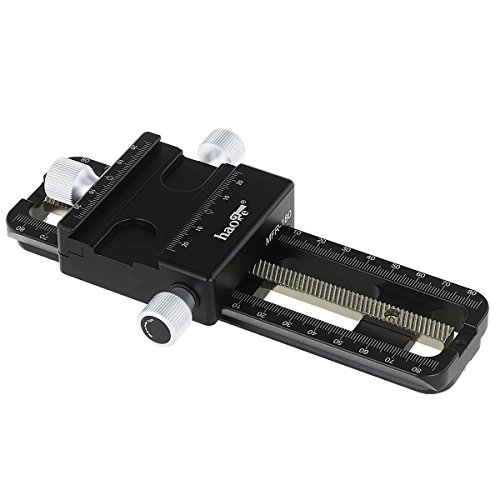
- Fine incremental adjustments for macro work
- Integrated Arca-type clamp and dovetail groove
- Useful for focus stacking and panoramas
Best For: Macro photographers using Arca-compatible accessories
Stability Upgrade
Fotopro FT-100PRO Macro Slider

- Smooth threaded drive and crank adjustment
- Rotating platform, level, damping, and lock
- Can stand independently on a desktop
Best For: Close-up setups needing versatile positioning
Budget Two-Way Rail

- Geared two-way movement with 80mm travel
- Rubber top helps protect and hold the camera
- Can combine with a second rail for four-way movement
Best For: Lightweight DSLR or DC macro setups
Best All-Around Pick – NEEWER 4-Way Macro Focusing Rail
If you want camera macro rails under 100 for flexible positioning, the NEEWER 4-Way Macro Focusing Rail offers separate left-right and forward-back adjustments. Numeric scales, large knobs, and a quick release plate make it practical for close-ups, macro work, and time-lapse shooting.
Best For: Photographers who need four-direction positioning and a relatively high 5.5-pound support rating.
Pros:
- Provides left, right, forward, and backward movement.
- Supports cameras up to 5.5 pounds while weighing 1.3 pounds.
- Includes a quick release plate, 1/4-inch camera screw, and silicone protection pad.
- Mounts to tripods or video heads through a 1/4-inch-20 socket or dovetails.
Cons:
- Requires locking the perpendicular adjustment knob for stable vertical-axis adjustments.
- It is not water resistant.
The NEEWER is a strong choice when versatility matters more than minimum weight. Its four-way design is especially useful when composing close-ups or making repeated positional changes.
Best for Fine Focus Stacking – Haoge FM-160 Wormdrive Macro Rail
Among camera macro rails under 100, the Haoge FM-160 stands out for controlled, incremental adjustment. Its worm-drive screw, 1mm reference scale, and 115mm front-to-back travel are well suited to precise close-up alignment and focus stacking.
Best For: Macro photographers who prioritize fine, repeatable front-to-back positioning and a lightweight setup.
Pros:
- Offers 115mm of front-to-back movement through an adjustment knob.
- Each full fine-adjustment rotation produces a 4mm stroke.
- Includes an Arca-type compatible clamp and dovetail groove.
- Weighs about 400g and includes 1mm laser-engraved scales.
Cons:
- Provides front-to-back movement rather than four-way adjustment.
- The listed maximum weight recommendation is 14.1 ounces.
- It is not water resistant.
The FM-160 is a focused tool for photographers who want controlled travel without carrying a heavier rail. Its Arca-style mounting also helps it integrate with compatible heads and accessories.
Best Long-Travel Option – Leftfoto Geared Macro Rail
The Leftfoto Geared Macro Focusing Rail is a compelling option among camera macro rails under 100 when you want a long adjustment range and geared control. Its 155mm travel, dual crank handles, and Arca-Swiss dovetail support detailed positioning for desktop or outdoor photography.
Best For: Users who need extended bidirectional travel for product, nature, or close-up photography.
Pros:
- Provides a 155mm adjustment range with bidirectional movement.
- Worm-gear control offers 1mm displacement per full rotation.
- Includes Arca-Swiss mounting plus 1/4-inch and 3/8-inch screw holes.
- CNC-machined construction is designed for smooth, wobble-free operation.
Cons:
- Weighs 1.1 pounds, making it heavier than some compact rails.
- The supplied dimensions do not specify its full width and height.
- It is not water resistant.
Choose the Leftfoto when travel length is a priority. The geared bidirectional design provides more positioning range than a compact single-axis rail, while the mounting options support varied tripod setups.
Best Simple Setup – ProMaster MR1 Macro Rail
For shoppers comparing camera macro rails under 100, the ProMaster MR1 focuses on straightforward, stable camera movement. Its quick release system and controlled adjustments are intended to simplify setup while helping maintain precise composition during macro photography.
Best For: Photographers seeking a practical macro rail with quick release operation and broad camera-and-lens compatibility.
Pros:
- Offers precise movement for fine focus and composition adjustments.
- Quick release design supports faster setup and repositioning.
- Provides smooth, controlled movement intended to reduce unwanted shifts.
- Built with durable materials for regular use.
Cons:
- The supplied notes do not specify its adjustment range.
- The supplied notes do not state a maximum supported camera weight.
- It is not water resistant.
The MR1 is a sensible pick when ease of setup matters more than detailed published specifications. Its quick release and stable movement make it suitable for general macro work across different camera and lens combinations.
Precision Pick – SIRUI MS18 Macro Focusing Rail
For camera macro rails under 100, the SIRUI MS18 stands out for its precision-focused design and flexible mounting options. A quick-adjustment button, side fine-tuning knob, and 360-degree rotating head make it practical for close-up photography and product work.
Best For: Photographers who want precise macro positioning, angle adjustment, and the option to build a four-way rail setup.
Pros:
- Quick-adjustment button supports faster positioning.
- Side knob allows tactile fine focus control.
- 360-degree rotating head and Arca-compatible quick-release plate add flexibility.
- Detachable feet support tabletop or tripod shooting.
Cons:
- Stacking two rails is needed for four-way adjustment.
- Not water resistant.
With a stated maximum load recommendation of 10 kg, the MS18 is a capable choice for users who value precise control and adaptable setup options in a compact macro rail.
Heavy-Duty Choice – Fotopro FT-100 PRO Macro Rail
Among camera macro rails under 100, the Fotopro FT-100 PRO offers a sturdy, feature-rich platform for close-up shooting. Its CNC-machined construction, smooth crank adjustment, rotating top module, and independent desktop feet are suited to detailed composition work.
Best For: DSLR and mirrorless users who want a stable rail with broad camera compatibility and smooth, controlled movement.
Pros:
- CNC-machined body, stainless-steel screw, and durable copper sliding parts.
- 14 mm of movement per knob turn supports faster focusing adjustments.
- 360-degree rotating top module, damping, and locking knob improve composition control.
- Removable feet allow stable desktop use without a tripod.
Cons:
- Its 7.4-inch design may be less compact than shorter rails.
- Not water resistant.
The FT-100 PRO is a strong all-around option when stability, smooth rack-and-pinion movement, and mounting versatility matter more than having the smallest possible rail.
Budget 4-Way Option – Generic 4-Way Macro Focusing Rail
If you are comparing camera macro rails under 100, this four-way slider provides basic positioning control at a straightforward level. Its two rails move the camera forward, backward, left, and right, while locking knobs help hold the selected position.
Best For: Entry-level macro photographers who need simple four-direction adjustment for close-up work.
Pros:
- Four-direction movement supports distance and lateral positioning.
- Locking knobs help keep the camera steady during focusing.
- Standard 1/4-inch screw compatibility suits cameras with that mounting interface.
Cons:
- Maximum recommended load is only 415 g.
- Plastic construction may be less robust than metal rails.
- Supplied notes identify the brand as Generic, so model-specific support may be limited.
This rail makes the most sense for lightweight camera setups and users who prioritize four-way adjustment over a higher load capacity or more advanced rotating hardware.
Best with Extra Features – Haoge MFR-180 Macro Focusing Rail
The Haoge MFR-180 is a practical choice among camera macro rails under 100 for photographers who need controlled, incremental camera movement. Its Arca-type clamp and dovetail groove also make it convenient for compatible tripod heads and accessories.
Best For: Focus stacking, macro photography, and nodal-slide panorama work.
Pros:
- Designed for small, precise positioning adjustments.
- Built-in Arca-type quick-release clamp and dovetail groove.
- Can serve as a nodal slide for panorama shooting.
Cons:
- Maximum weight recommendation is listed as 14.1 ounces.
- Not water resistant.
The MFR-180 stands out for its integrated Arca-compatible mounting features and focus-stacking orientation. Check your camera and head setup against the listed weight recommendation before buying.
Stability Upgrade – Fotopro FT-100PRO Macro Slider
The Fotopro FT-100PRO is a feature-rich option among camera macro rails under 100, combining a precision threaded drive with adjustable positioning for close-up shooting. Its removable foot pegs also allow stable desktop use without a tripod.
Best For: Close-up photographers who want flexible positioning, angle adjustment, and desktop stability.
Pros:
- Precision multi-headed threaded screw with smooth crank adjustment.
- 360-degree rotating top module, damping, locking knob, and built-in level.
- Supports horizontal and vertical setup with universal dovetail compatibility.
- Removable non-slip foot pegs enable independent desktop use.
Cons:
- Its 7.4-inch folded size may take more storage space than compact rails.
- Not water resistant.
The FT-100PRO is the most versatile choice in this group for users who value stability and multi-axis adjustment. Its extensive controls may be more than needed for simple macro positioning.
Budget Two-Way Rail – EXMAX LP-01 Macro Slider
The EXMAX LP-01 is a straightforward camera macro rail under 100 with geared two-way movement and an 80mm adjustment range. Its rubber top helps protect the camera base while the locking controls support steady close-up composition.
Best For: DSLR or DC users who want affordable two-way macro positioning and optional flash-bracket functionality.
Pros:
- Rack-and-pinion movement provides fine front-to-back or side-to-side adjustment.
- Rubber top surface increases friction and helps reduce camera abrasion.
- Compatible with standard 1/4-inch camera mounts and tripod heads.
- Two rails can be combined into a four-direction macro slider.
Cons:
- Maximum weight recommendation is listed as 7.04 ounces.
- The 80mm movement range may be limiting for some setups.
- Not water resistant.
The LP-01 offers useful geared control in a compact, lightweight design. Its low listed weight recommendation makes it best suited to lighter camera and lens combinations.
How We Picked the Best Camera Macro Rails Under 100
We focused on the features that matter most during close-up work: smooth or geared adjustment, useful travel range, stable construction, secure camera mounting, and compatibility with common tripod heads and quick-release systems. We also considered whether each rail supports one-axis or two-axis positioning, since that affects both focusing and composition.
At this price, buyers should expect compromises. Some rails prioritize compactness, while others provide longer travel or more precise worm-drive control. Product listings can also vary by included plates, screw types, and stated load capacity, so confirm the specifications before ordering.
Quick Comparison
| Rail type | Best suited for | Main advantage |
|---|---|---|
| Two-way rail | Basic focus adjustment | Simpler, lighter setup |
| Four-way rail | Composition and focus control | Movement in multiple directions |
| Geared or worm-drive rail | Focus stacking and fine adjustments | More controlled positioning |
| Long-travel rail | Large subjects and varied working distances | Greater adjustment range |
Key Buying Factors for Camera Macro Rails Under $100
Adjustment Precision
A geared or worm-drive mechanism is generally easier to control than a basic sliding rail, especially when making tiny focus changes for stacked images. Look for a firm adjustment knob and minimal play.
Travel and Direction
One-axis rails are often enough when the camera is already aligned with the subject. Four-way designs are more versatile for reframing, centering, and adjusting front-to-back focus without moving the tripod.
Mounting Compatibility
Check whether the rail uses a standard 1/4-inch camera screw, an Arca-Swiss-style plate, or a proprietary quick-release system. Confirm that the rail fits both your camera or lens collar and your tripod head.
Stability and Build
Aluminum construction keeps the rail portable, but rigidity matters more than low weight for macro work. Look for a broad base, secure locking points, and minimal wobble when the camera is extended.
Working Setup
Consider your lens, focusing distance, and whether you shoot indoors or outdoors. A compact rail suits field work, while a longer, more precise model can be preferable for controlled studio focus stacking.
Who Should Buy Which Camera Macro Rails Under 100?
Choose a simple two-way rail if you want an affordable way to fine-tune focus with a tripod-mounted camera. Choose a four-way model if you frequently adjust framing or need more control over subject placement. A geared or worm-drive rail is the better choice for repeatable focus-stacking steps, product photography, and other work where small movements affect sharpness. If you use an Arca-Swiss tripod head, prioritize a rail with a compatible plate or a clearly specified interchangeable mounting system.
Before buying, verify the rail’s dimensions, travel distance, screw standard, and camera support. The best value is the model that matches your mounting setup and provides enough precision for your subjects—not simply the one with the longest rail or most adjustment axes.