Camera lens adapters with focal reducers can make older lenses more useful by widening the field of view, increasing effective brightness, and helping smaller sensors capture a look closer to the original lens design.
This roundup covers electronic and manual adapters for Canon EF, Nikon F, Mamiya 645, Pentax 67, C-mount, and other systems. The right choice depends on mount compatibility, autofocus needs, sensor coverage, and how much optical reduction your setup can handle.
Best 10 Camera Lens Adapters with Focal Reducers Picks for 2026
Fuji X Autofocus Booster
VILTROX EF-FX2 Pro 0.71x Adapter

- Adapts Canon EF lenses to Fujifilm X-mount cameras
- Supports autofocus, aperture, EXIF, and IS functions
- Lightweight metal body with USB firmware updates
Best For: Fuji X users adapting Canon EF lenses with electronic control
Telescope Imaging Reducer
SVBONY 1.25-inch C-Mount Adapter

- Connects C-mount cameras to 1.25-inch telescope tubes
- Designed for a faster system and wider field of view
- Threaded interior and broadband green-coated lens
Best For: Telescope eyepiece photography with C-mount cameras
RF Cinema Speed Booster

- Adapts Canon EF lenses to selected RF APS-C and S35 cameras
- Adds 0.71x reduction and approximately one stop of light
- Supports autofocus, aperture, and anti-shake functions
Best For: Canon RF crop-sensor and cinema camera users with EF lenses
Micro Four Thirds Booster
VILTROX EF-M2 II 0.71x Adapter

- Adapts Canon EF lenses to Micro Four Thirds cameras
- Adds roughly one stop of light and 0.71x focal reduction
- Offers autofocus, aperture control, IS support, and USB updates
Best For: Panasonic and Olympus M4/3 users adapting Canon EF lenses
Best All-Around MFT Speed Booster
VILTROX EF-M2 PRO 0.71x Adapter
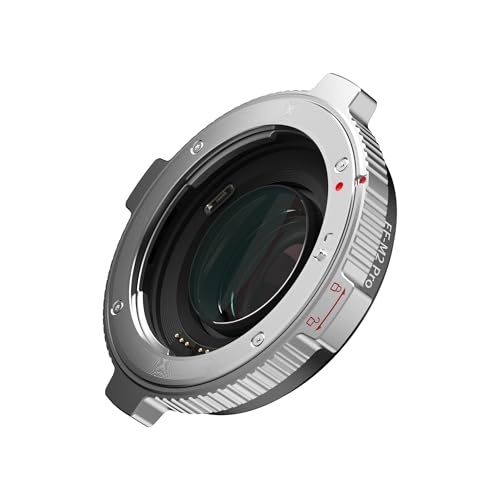
- 0.71x reduction for a wider, brighter image
- Autofocus, aperture, EXIF, and stabilization support
- Security lock and USB-C firmware updates
Best For: MFT users adapting Canon EF/EF-S lenses
Best Manual-Only Option
Mamiya 645 to L-Mount 0.71x Reducer

- 0.71x reduction for a wider field of view
- Secure threaded flange-locking mechanism
- Manual focus with no EXIF transmission
Best For: Manual shooters adapting Mamiya 645 lenses to L Mount
Best Value Electronic Adapter
VILTROX EF-M2 II 0.71x Booster

- 0.71x optical focal reducer for MFT
- Autofocus and in-camera aperture control
- EXIF transmission and USB firmware support
Best For: MFT users adapting Canon EF lenses
Large-Format Cinema Reducer

- 0.71x reduction for a wider field of view
- Threaded flange lock for a secure fit
- Manual focus with no EXIF transmission
Best For: Pentax 67 lenses on PL-mount cinema cameras
Autofocus Speed Booster
VILTROX EF-EOS M2 0.71x Adapter

- Autofocus and camera-controlled aperture
- One-stop aperture increase
- EXIF and IS support with metal construction
Best For: Canon EF lenses on Canon EF-M mirrorless cameras
Manual Nikon-to-MFT Reducer

- Adapts Nikon G/D lenses to MFT cameras
- One-stop aperture increase with 0.71x reduction
- Manual focus and built-in aperture control
Best For: Manual Nikon lens setups on Micro Four Thirds cameras
Fuji X Autofocus Booster – VILTROX EF-FX2 Pro 0.71x Adapter
For photographers building a Fuji X system around Canon EF glass, the VILTROX EF-FX2 Pro is a practical choice among camera lens adapters with focal reducers. Its 0.71x optical reduction helps widen the effective view and increase light transmission, while electronic contacts support autofocus, aperture control, EXIF transmission, and image stabilization functions.
Best For: Fuji X-mount users who want to adapt Canon EF lenses while retaining electronic camera controls.
Pros:
- 0.71x focal reduction with built-in optical correction.
- Supports autofocus, camera-controlled aperture, EXIF data, and IS functions.
- Lightweight 162.5 g all-metal construction with a micro USB port for firmware updates.
Cons:
- Designed for Fujifilm X-mount cameras and Canon EF lenses, so compatibility must be checked carefully.
- The listed camera compatibility covers many Fuji models but may not represent every X-mount body.
The EF-FX2 Pro stands out when retaining electronic functionality matters as much as focal reduction. Confirm your exact body and lens combination before buying, then use the USB connection for potential firmware updates.
Telescope Imaging Reducer – SVBONY 1.25-inch C-Mount Adapter
The SVBONY focal reducer setup is aimed at telescope and camera imaging rather than interchangeable-lens photography. It combines a 1.25-inch telescope interface with a C-mount camera adapter and a reducer lens to create a faster system with a wider field of view.
Best For: Telescope users connecting a C-mount video or CCD camera through a standard 1.25-inch focus tube.
Pros:
- Includes a C-mount adapter and reducer lens for telescope photography.
- Fits standard 1.25-inch focus tubes and C-mount cameras.
- Fully threaded interior helps minimize reflections, and the lens has broadband green coating.
Cons:
- Manual-focus design does not provide electronic camera control.
- Intended for telescope and C-mount setups, not Canon, Nikon, or mirrorless lens conversion.
- The supplied notes contain both 0.25x and 0.5x reduction references, so verify the exact configuration before purchase.
This is a specialized option for astronomy and telescope imaging. Its 1.25-inch fit and C-mount connection are the key buying checks, especially because the supplied specifications describe the reduction ratio inconsistently.
RF Cinema Speed Booster – Meike EF-to-RF 0.71x Adapter
The Meike 0.71X Speedbooster is built for selected Canon RF APS-C and Super 35-style cameras that need access to Canon EF lenses. Its focal reduction can improve light transmission by about one stop, while electronic contacts support autofocus, aperture, and stabilization functions.
Best For: Canon RF APS-C or S35 camera owners using compatible Canon EF lenses for photography or cinema work.
Pros:
- 0.71x reduction helps reduce focal length and increase aperture by one stop.
- Supports autofocus, automatic aperture, and anti-shake functions.
- Rotary locking design enables quick lens changes, with a dust-resistant rubber ring at the RF mount.
Cons:
- Not compatible with RF full-frame cameras or EF-S APS-C lenses.
- Compatibility is limited to specified RF APS-C and cinema bodies, including the EOS C70, R50, R10, R7, and Komodo.
- Its 9.2-ounce weight adds more bulk than a basic non-reducing adapter.
The Meike is compelling when you need a focal reducer for a supported RF crop-sensor or cinema camera. The full-frame RF and EF-S exclusions are significant, so confirm both camera and lens mount before ordering.
Micro Four Thirds Booster – VILTROX EF-M2 II 0.71x Adapter
The VILTROX EF-M2 II gives Micro Four Thirds photographers a way to use Canon EF lenses with a 0.71x focal reducer. It is one of the more feature-rich camera lens adapters with focal reducers, adding autofocus, aperture control, electronic contacts, image stabilization support, a tripod foot, and USB firmware updating.
Best For: Panasonic and Olympus Micro Four Thirds users who want wider, brighter results from Canon EF lenses.
Pros:
- 0.71x reduction helps widen the effective focal length and increase light by about one stop.
- Supports autofocus, camera-controlled aperture, electronic contacts, and IS functions.
- Metal bayonets, a 1/4-inch tripod foot, and USB firmware updates add practical versatility.
Cons:
- Compatibility is limited to Micro Four Thirds cameras and Canon EF lenses.
- Autofocus and electronic features can depend on the specific lens and camera combination.
- It weighs approximately 0.26 kg, adding noticeable support hardware to a compact system.
The EF-M2 II is a strong fit for M4/3 owners who value both focal reduction and electronic lens communication. Check the extensive compatibility list and allow for the adapter’s added weight when planning handheld or gimbal setups.
Best All-Around MFT Speed Booster – VILTROX EF-M2 PRO 0.71x Adapter
If you want camera lens adapters with focal reducers for a Micro Four Thirds setup, the VILTROX EF-M2 PRO combines a 0.71x reducer with electronic lens communication. It is designed to make Canon EF and EF-S lenses wider and brighter while retaining convenient in-camera controls.
Best For: MFT photographers and videographers using Canon EF/EF-S lenses on cameras such as Panasonic GH-series, Olympus, BMPCC4K, or Z CAM models.
Pros:
- 0.71x focal reduction provides a wider view and about one extra stop of light.
- Supports autofocus, electronic aperture control, EXIF transmission, and lens-based stabilization.
- Security lock, all-metal construction, and USB-C firmware updates add practical usability.
Cons:
- Compatibility depends on the specific EF/EF-S lens and MFT camera combination.
- At 10.6 ounces, it adds noticeable weight to a compact setup.
This is the most feature-rich option here for users who want a more cinematic field of view and low-light help without giving up electronic lens functions.
Best Manual-Only Option – Mamiya 645 to L-Mount 0.71x Reducer
This Mamiya 645-to-L-Mount adapter is a straightforward choice among camera lens adapters with focal reducers when your priority is a wider field of view rather than electronic automation. Its 0.71x reducer and precision-machined construction suit manual-focus workflows.
Best For: Photographers using Mamiya 645 lenses on Leica or Panasonic L-Mount cameras who are comfortable setting focus and exposure manually.
Pros:
- 0.71x focal reduction helps widen the view and reduce the crop effect.
- Threaded flange-locking mechanism is designed for a secure, shake-free fit.
- CNC-machined construction and precision infinity focus support careful manual shooting.
Cons:
- Manual focus only, with no EXIF data transmission.
- May require enabling “Shoot without lens” if the camera will not release the shutter.
Choose this adapter for a controlled, hands-on setup with Mamiya 645 glass. It is less suitable if you need autofocus, electronic aperture control, or lens data communication.
Best Value Electronic Adapter – VILTROX EF-M2 II 0.71x Booster
The VILTROX EF-M2 II is a practical pick for camera lens adapters with focal reducers if you use Canon EF lenses on a Micro Four Thirds body. Its 0.71x optical reducer works alongside autofocus, aperture control, EXIF transmission, and firmware-upgrade support.
Best For: MFT owners using compatible Canon EF lenses on cameras including Panasonic GH models, Olympus bodies, the PEN-F, GF9, or GX85.
Pros:
- 0.71x reducer helps produce a wider effective view on MFT cameras.
- Electronic contacts support autofocus, aperture adjustment, and EXIF transmission.
- USB firmware port can support later improvements and bug fixes.
Cons:
- Compatibility and autofocus performance can vary by camera and lens combination.
- The adapter is intended for Canon EF lenses and MFT cameras, limiting mount flexibility.
This model offers a useful balance of focal reduction and electronic functionality for everyday MFT shooting, especially if you already own compatible Canon EF glass.
Large-Format Cinema Reducer – Pentax 67 to PL 0.71x Adapter
This Pentax 67-to-PL adapter is a specialized option among camera lens adapters with focal reducers, reducing the crop factor by 0.71x for a wider field of view. Its threaded flange-locking design is intended to provide a secure, shake-free connection on compatible cinema camera setups.
Best For: Cinema shooters using Pentax 67 lenses on PL-mount cameras who prefer a secure manual-focus setup.
Pros:
- 0.71x focal reduction provides a wider field of view.
- Threaded flange-locking mechanism helps stabilize the lens connection.
- CNC-machined construction supports accurate infinity focus.
Cons:
- Manual focus only.
- Does not transmit lens EXIF data.
- Compatibility is limited to Pentax 67 lenses and PL-mount cameras.
Choose this adapter when mechanical security and reliable infinity focus matter more than electronic communication. It is a focused tool for compatible cinema rigs rather than a general-purpose adapter.
Autofocus Speed Booster – VILTROX EF-EOS M2 0.71x Adapter
The VILTROX EF-EOS M2 is a practical choice among camera lens adapters with focal reducers for pairing Canon EF lenses with Canon EF-M mirrorless cameras. Its 0.71x reducer widens the effective view and increases aperture by one stop while retaining autofocus and camera-controlled aperture functions.
Best For: Canon EOS M users who want to adapt EF lenses while keeping autofocus, aperture control, EXIF transmission, and image stabilization support.
Pros:
- 0.71x reduction creates a wider effective field of view.
- Increases aperture by one stop for more background blur and light-gathering capability.
- Supports autofocus, aperture control, EXIF transmission, and built-in IS functionality.
- Metal construction includes a tripod-support screw and firmware-update support.
Cons:
- Designed specifically for Canon EF lenses and EF-M cameras.
- Not water resistant.
- Electronic performance may depend on supported lens and camera combinations.
This is the strongest fit for EOS M owners who want more than a purely mechanical connection. The electronic features make it more versatile, while the dedicated EF-to-EF-M compatibility limits it to that camera system.
Manual Nikon-to-MFT Reducer – VILTROX NF-M43X 0.71x Adapter
The VILTROX NF-M43X is a manual option among camera lens adapters with focal reducers, allowing Nikon G/D lenses to be used on Micro Four Thirds cameras. Its 0.71x reduction broadens the field of view and increases maximum aperture by one stop, while the built-in ring provides manual aperture adjustment.
Best For: Photographers and filmmakers using Nikon G/D lenses on Micro Four Thirds cameras who want direct manual control.
Pros:
- 0.71x focal reducer offers a wider field of view.
- One-stop aperture increase can improve low-light performance.
- Built-in aperture ring provides control with Nikon G lenses.
- Optical glass construction supports image quality and infinity focus.
Cons:
- Manual focus design provides no autofocus.
- No image stabilization.
- Exposure and aperture operation are manual.
This adapter suits users who are comfortable managing focus and exposure themselves. Its Nikon-to-Micro Four Thirds compatibility and aperture ring make it especially useful for adapting older or fully manual shooting workflows.
How We Picked the Best Camera Lens Adapters with Focal Reducers
We organized these 10 options by their intended lens and camera mounts, reduction factor, control features, and likely use case. Most photographic speed boosters here use a 0.71x focal reducer, while the telescope-focused model uses a much stronger reduction intended for a different optical application. We also separated electronic adapters from manual designs because autofocus, aperture communication, and camera-body compatibility can vary significantly.
Before buying, verify the exact mount names on both the lens and camera. A physically fitting adapter is not automatically optically or electronically compatible.
Quick Comparison
- Canon EF to Fujifilm X: Look for an adapter with electronic communication and autofocus support, such as the Viltrox EF-FX2 Pro.
- Canon EF to Micro Four Thirds: The Viltrox EF-M2 II and EF-M2 Pro provide 0.71x reduction, with electronic versions suited to supported EF lenses.
- Canon EF to Canon EF-M: The Viltrox EF-EOS M2 is designed for EOS M mirrorless cameras.
- Canon EF to Canon RF: The Meike 0.71x model is intended for compatible RF bodies, but confirm camera and lens support before ordering.
- Manual lens conversions: Nikon G, Mamiya 645, and Pentax 67 options are better suited to controlled focusing and video workflows.
- Telescope use: The SVBONY C-mount reducer is a specialized astronomical accessory, not a general-purpose photographic speed booster.
Key Buying Factors for Camera Lens Adapters with Focal Reducers
Mount and Sensor Compatibility
Confirm both mount standards and the intended sensor format. A reducer designed for Micro Four Thirds may not cover a larger sensor without vignetting, while a medium-format lens adapter may require careful checking for image-circle coverage and flange distance.
Reduction Factor and Effective Brightness
A 0.71x reducer shortens the effective focal length and concentrates light onto the sensor, typically providing about one stop of additional exposure compared with using the lens without reduction. Actual results depend on the lens, sensor, and adapter optics.
Electronic Controls
Electronic models may support autofocus, aperture control, EXIF data, and lens stabilization, but support is lens- and body-dependent. Manual adapters are simpler and can be more reliable for adapted vintage lenses, especially when shooting video or using fully manual optics.
Build Quality and Locking Security
Heavy lenses need a rigid mount, minimal play, and a dependable locking mechanism. Security locks and tripod-foot support can be valuable with large zooms or medium-format glass.
Who Should Buy Which Camera Lens Adapters with Focal Reducers?
Choose an electronic Canon EF adapter if you want to reuse autofocus EF lenses on Fujifilm X, Micro Four Thirds, RF, or EF-M cameras. Choose a manual Nikon, Mamiya, or Pentax adapter if you prioritize cinema-style control, vintage rendering, or a straightforward mechanical connection. Choose the telescope reducer only for compatible C-mount astronomical or imaging equipment. For any option, check current firmware notes, supported lens lists, clearance, and return policies before purchasing.