The right hatchet can make campsite tasks faster, from preparing kindling and trimming branches to driving tent stakes. The best choice balances cutting performance, carry comfort, safety, and durability without adding unnecessary weight to your pack.
We compared 10 hatchet camping axes across blade design, handle construction, portability, grip, and intended use so you can choose a practical tool for weekend camping, hiking, survival kits, or regular firewood preparation.
Best 10 Hatchet Camping Axes Picks for 2026
Best Lightweight Pick

- Lightweight 14-inch format
- Low-friction forged-steel blade
- Shock-absorbing grip and sheath
Best For: Campfire kindling and small wood
Best Traditional Build

- One-piece forged steel construction
- Genuine leather grip
- Ballistic nylon sheath included
Best For: Durable camp and firewood work
Best Compact Pack Option

- Compact 9.46-inch design
- Full-tang corrosion-resistant blade
- Pack- or belt-mountable sheath
Best For: Hiking, backpacking, and survival kits
Best Multipurpose Camp Tool

- Drop-forged steel construction
- Non-slip rubber grip
- Built-in tent stake puller
Best For: Campsite wood splitting and tent setup
Balanced Beechwood Pick
13.5-Inch Carbon Steel Hatchet

- 1065 carbon steel head with beechwood handle
- Balanced 2.1-pound design for controlled swings
- Leather sheath included
Best For: Small campfire wood, branches, gardening, and light woodwork
Multitasker Pick

- Heat-treated 45 carbon steel blade
- Shock-reducing fiberglass handle with anti-slip grip
- Built-in hammer back and locking blade cover
Best For: Kindling, small logs, tent stakes, hiking, and yard cleanup
Ultralight Adventure Pick
Fiskars X13 13-Inch Hiking Axe

- 15% lighter than other compact X-series axes
- Forged steel blade with low-friction coating
- Bright handle, sheath, and stake-driving end
Best For: Hiking, backpacking, camping, and efficient kindling cuts
Throwing-Ready Camp Tool
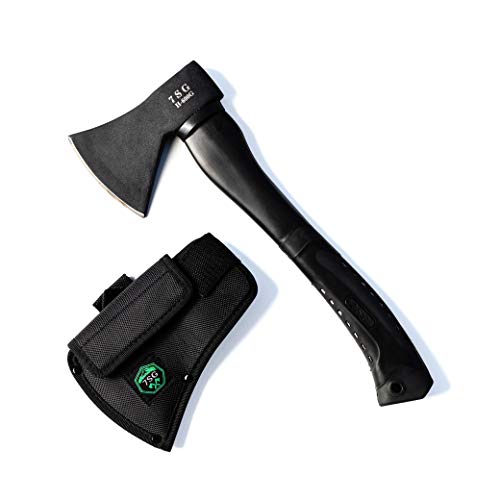
- Narrow profile designed for axe throwing
- Fiberglass handle keeps pack weight down
- Sheath and flat hammer back add field utility
Best For: Light camp chores, brush clearing, and recreational axe throwing
Hand-Forged Splitting Pick
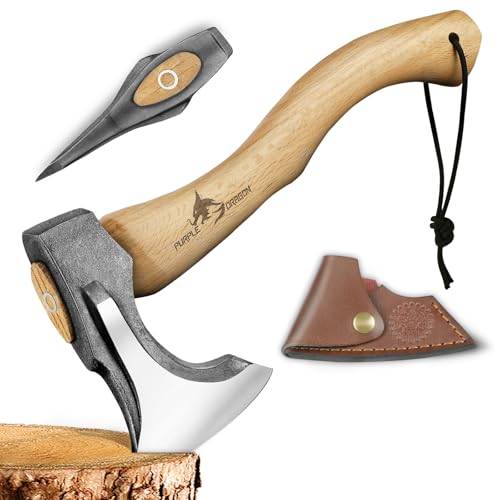
- Wedge geometry targets efficient wood splitting
- Hand-forged steel is rated 56–60 HRC
- Hickory handle and leather sheath included
Best For: Campfire wood splitting, delimbing, bushcraft, and garden work
Multitool Emergency Option
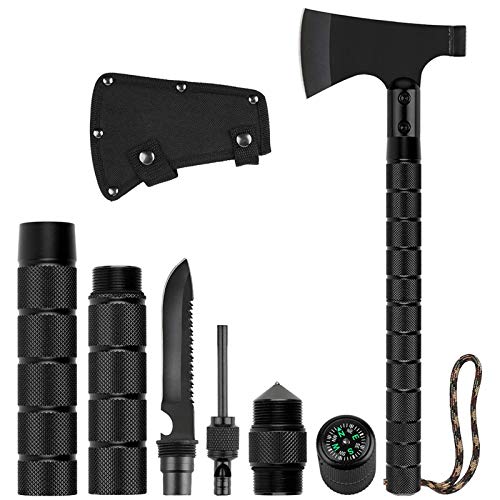
- Folding design supports compact transport
- Adjustable handle length adds flexibility
- Includes fire starter, whistle, compass, and more
Best For: Preparedness kits, hiking, hunting, camping, and emergency use
Best Lightweight Pick – Fiskars X7 Small Hatchet
For shoppers comparing hatchet camping axes, the Fiskars X7 is a lightweight 14-inch option designed for preparing firewood, splitting kindling, and removing branches. Its balanced design and low-friction blade aim to make repeated campsite chores more manageable.
Best For: Campfire kindling, small-to-medium firewood, and general campsite branch clearing.
Pros:
- Lightweight 1.4-pound design with a 5.12-inch forged-steel blade.
- Balanced weight distribution supports efficient swings.
- Shock-absorbing FiberComp handle, non-slip grip, low-friction coating, and included sheath.
- Backed by a lifetime manufacturer limited warranty.
Cons:
- Its small-hatchet format is intended for kindling and smaller wood rather than heavy-duty chopping.
- The 14-inch handle provides less reach than a full-size axe.
The X7 stands out when portability and reduced hand fatigue matter more than maximum splitting capacity. It is a practical choice for routine campfire preparation.
Best Traditional Build – Estwing Sportsman's Axe
The Estwing Sportsman’s Axe is a sturdy choice among hatchet camping axes, combining a 14-inch profile with a one-piece forged American-steel construction. It is sized for chopping branches, splitting kindling, and handling other common outdoor tasks.
Best For: Campers who want a durable, traditionally styled hatchet for branches, kindling, firewood, and tent stakes.
Pros:
- Forged in one piece to avoid weak points from welds or castings.
- Genuine hand-sanded and lacquered leather grip offers a comfortable hold.
- Includes a ballistic nylon sheath with belt loop for carrying.
- Made in the USA and equipped with a hand-sharpened 4-inch cutting edge.
Cons:
- At 1.8 pounds, it is heavier than the Fiskars X7 and Gerber Pack Hatchet.
- The leather grip may require more care than synthetic handle materials.
With its solid one-piece steel construction and leather handle, the Estwing favors durability and a classic feel. Choose it if a robust, multipurpose camp axe is a higher priority than minimum pack weight.
Best Compact Pack Option – Gerber Pack Hatchet
The Gerber Pack Hatchet is one of the most compact hatchet camping axes in this roundup. Its 9.46-inch overall length, full-tang steel blade, and pack- or belt-mountable sheath make it convenient for hiking, camping, hunting, and survival-oriented kits.
Best For: Backpackers, hikers, and campers who prioritize compact carry and convenient storage.
Pros:
- Compact 9.46-inch overall length and 1.3-pound weight.
- Full-tang, corrosion-resistant steel blade with a 3.5-inch tall grind.
- Ergonomic rubber handle includes finger grooves for added control.
- Removable nylon sheath mounts to a pack or belt and includes a lanyard hole.
Cons:
- The compact 3.5-inch blade is less suited to larger firewood than longer hatchets.
- Its smaller size limits reach for heavier chopping tasks.
The Gerber is a sensible everyday-carry-style hatchet for outdoor kits where space and accessibility matter. It is best viewed as a portable cutting tool rather than a large splitting axe.
Best Multipurpose Camp Tool – Coleman Camping Axe
The Coleman Camping Axe is a practical option among hatchet camping axes for campsite chores that go beyond chopping. Its drop-forged steel head, steel handle, non-slip rubber grip, and stake-puller notch support wood splitting and tent setup.
Best For: Campers who want one tool for splitting wood, pulling tent stakes, and general campsite use.
Pros:
- Drop-forged alloy-steel head paired with a robust steel handle.
- Non-slip rubber grip is designed for a secure, comfortable hold.
- Stake-puller notch adds useful tent-camping functionality.
- 13-inch length balances compact storage with campsite usability.
Cons:
- At 2 pounds, it is the heaviest option in this roundup.
- The 3-inch blade is shorter than the Fiskars and Estwing cutting edges.
- The steel handle may transmit more impact than a shock-absorbing composite handle.
The Coleman makes sense for car camping and campsite tasks where versatility is more important than ultralight carry. Its stake-puller notch is a useful differentiator for tent setup.
Balanced Beechwood Pick – 13.5-Inch Carbon Steel Hatchet
For shoppers comparing hatchet camping axes, this compact 13.5-inch model offers a traditional beechwood handle, a 1065 carbon steel head, and a balanced 2.1-pound build. It is sized for controlled chopping around camp, in the garden, or during light woodwork.
Best For: Campers and DIY users who want a portable hatchet for small logs, firewood, and clearing branches.
Pros:
- 1065 high-carbon steel is designed for strength and edge retention.
- Beechwood handle provides a traditional, sturdy grip.
- Balanced 13.5-inch, 2.1-pound design helps support controlled swings.
- Includes a leather sheath for carrying and storage.
Cons:
- Its compact size is intended for smaller jobs rather than large logs.
- The wood handle may require more care than a synthetic handle.
This is a straightforward choice among hatchet camping axes when balance, portability, and a classic wood-handled design matter more than maximum chopping capacity.
Multitasker Pick – 15-Inch Chopping Hatchet
This 15-inch option stands out among hatchet camping axes for its heat-treated 45 carbon steel blade, shock-reducing fiberglass handle, and built-in hammer back. At 600 grams, it is designed for portable campfire preparation, kindling, and general outdoor cleanup.
Best For: Campers, hikers, and yard users who want one compact tool for chopping, splitting small wood, and driving stakes.
Pros:
- Heat-treated carbon steel blade is suited to kindling and small logs.
- Fiberglass handle with an anti-slip grip helps absorb impact.
- Flat hammer back can drive tent and wooden stakes.
- Locking blade cover supports safer carrying and storage.
Cons:
- The 600-gram head is geared toward lighter chopping tasks.
- Its modern fiberglass handle may not appeal to users who prefer wood.
Choose this model if you value versatility in a compact package. The hammer back adds useful camp functionality without requiring a separate hammer.
Ultralight Adventure Pick – Fiskars X13 13-Inch Hiking Axe
For hikers and backpackers comparing hatchet camping axes, the Fiskars X13 combines a 13-inch format with a design that is 15% lighter than other compact X-series axes. Its forged steel blade, bright orange FiberComp handle, and included sheath make it practical for portable outdoor use.
Best For: Hiking, backpacking, and camping trips where low weight, visibility, and efficient kindling cuts are priorities.
Pros:
- Lightweight, balanced design is made for easy stowage and outdoor carrying.
- Double-hardened forged steel blade is designed to maintain its edge.
- Low-friction coating supports smoother cuts and rust protection.
- Bright orange handle, striking end, sheath, and belt loop add practical trail features.
Cons:
- Its 13-inch size is better suited to kindling and compact camp tasks than heavy chopping.
- The orange synthetic handle may be less appealing to traditionalists.
The X13 is a strong fit when portability is central to your buying decision. Its visibility and stake-driving end are especially useful for organized camp setups.
Throwing-Ready Camp Tool – Lightweight Tactical Hatchet
This compact option stands out among hatchet camping axes for its narrow profile, throwing-oriented design, and lightweight fiberglass handle. Its 6-inch head, 20-degree angle, flat hammer-style back, and included ballistic nylon sheath make it suited to several camp and field tasks.
Best For: Campers who want a lightweight hatchet for chopping, clearing brush, driving stakes, and recreational axe throwing.
Pros:
- Narrow profile and sharp head are designed for axe throwing.
- Lightweight fiberglass and rubber handle helps with portability and grip.
- Flat back can serve as a hammer for driving stakes.
- Ballistic nylon sheath provides blade coverage and attachment loops.
Cons:
- Its throwing-axe focus may be less suitable for users seeking a dedicated heavy wood-splitting tool.
- The supplied dimensions list a 1.2-pound item weight and a 1.3-pound head weight, so buyers should verify fit and balance for their intended use.
This is a versatile, packable pick for light camp chores and survival-oriented tasks, especially if throwing capability is part of your interest. The sheath and hammer poll add practical utility in camp.
Hand-Forged Splitting Pick – Hickory Camping Hatchet
For shoppers comparing hatchet camping axes for wood processing, this hand-forged Purple Dragon model emphasizes splitting efficiency. Its carbon-manganese steel head, wedge-shaped profile, S-curve hickory handle, and leather sheath are designed for camping, bushcraft, garden, and forest work.
Best For: Outdoor users who prioritize splitting wood and delimbing with a traditional wooden-handled axe.
Pros:
- Wedge-shaped head is intended to improve splitting efficiency.
- Hand-forged high-strength steel is hardened and polished to a stated 56–60 HRC.
- S-curve hickory handle is designed for grip, balance, and shock absorption.
- Includes rubber cutting protection and a hand-stitched leather sheath.
Cons:
- At 1.1 kg, it is heavier than some compact hatchets for backpacking.
- The recommended water soak before use adds preparation for buyers wanting immediate deployment.
- Its splitting-wedge design may be less versatile for fine carving or general-purpose camp tasks.
This model makes the most sense when processing firewood is the priority. The traditional hickory handle and splitting geometry favor controlled wood work over ultralight portability.
Multitool Emergency Option – Folding Survival Hatchet
This LIANTRAL model takes a different approach to hatchet camping axes by combining a folding, adjustable-length design with a broad set of emergency features. Along with its carbon-steel blade and alloy handle, the kit includes tools such as a fire starter, whistle, compass, hammer, bottle opener, and fish scaler.
Best For: Campers, hikers, hunters, and emergency-minded users who value compact carry and multiple built-in tools.
Pros:
- Folding construction and sheath make it compact for transport.
- Adjustable extension bars allow handle length changes for different tasks.
- Combines chopping with hammering and several emergency functions.
- Carbon-steel blade and thick aluminum-alloy handle components support outdoor use.
Cons:
- Its 2.2-pound weight is relatively substantial for a folding emergency tool.
- The many integrated features may appeal less to buyers seeking a simple, dedicated hatchet.
- Supplied notes describe a standard blade edge rather than a specialized splitting profile.
This is best viewed as a portable preparedness kit with an axe function rather than a minimalist wood-processing hatchet. Its adjustable handle and emergency accessories provide flexibility for outdoor and backup use.
How We Picked These Hatchet Camping Axes
We focused on the features that matter most outdoors: a useful blade length, secure handling, durable head materials, comfortable grips, protective sheaths, and a size that is practical to carry. The selection includes compact pack hatchets, traditional wood-handled models, ultralight hiking axes, folding designs, and sturdier options for repeated kindling and small-log work.
Because product specifications and user needs vary, consider each model’s stated materials, dimensions, weight, and intended tasks before buying. A small hatchet is not a substitute for a full-size splitting axe, and no camping axe should be used on oversized logs or for tasks beyond its design.
Quick Comparison
| Best For | Look For | Typical Advantage |
|---|---|---|
| General camping | 14-inch handle and balanced head | Versatile for kindling and campsite chores |
| Backpacking | Lightweight construction and compact profile | Easier to carry over long distances |
| Heavy kindling work | Forged or hardened steel head | Better durability under repeated use |
| Emergency or survival kits | Protective sheath and compact storage | Convenient to pack and deploy |
| General value | Secure grip, usable sheath, and solid construction | Practical performance without unnecessary features |
Key Buying Factors for Hatchet Camping Axes
Blade and Head Construction
Steel quality affects edge retention, toughness, and maintenance. A sharp, properly protected edge improves efficiency, but it still requires careful storage and occasional sharpening. Forged or hardened heads are often favored for demanding use, while lighter designs may be preferable when pack weight matters most.
Handle Length and Material
Longer handles generally provide more leverage, while shorter handles are easier to control in tight spaces. Wood handles can offer traditional shock absorption and may be replaceable; composite or fiberglass handles typically resist weather and require less maintenance. Whichever material you choose, the grip should remain secure with wet or gloved hands.
Weight, Balance, and Portability
A heavier head can help with splitting but becomes tiring during hikes or extended work. Look for a balanced tool that feels controllable rather than simply choosing the lightest or heaviest option. A sheath, lanyard point, or folding mechanism can also improve transport, but moving parts should be checked regularly.
Safety and Maintenance
Use a sheath whenever the axe is stored or carried, and inspect the handle, head, and fasteners before each use. Keep the edge clean and appropriately sharp, wear eye protection, clear the swing area, and place wood on a stable surface. Never chop toward your body or leave a loose axe accessible around children.
Who Should Buy Which Hatchet Camping Axes?
Choose a compact or ultralight model if you hike to dispersed campsites and mainly need to prepare small kindling. A balanced 13- to 14-inch hatchet is the best all-around choice for car camping, firewood preparation, and routine campsite tasks. Pick a sturdier steel-headed model if durability and repeated chopping matter more than minimum pack weight. Folding and survival-oriented designs suit emergency kits and limited storage, provided their locking mechanism and sheath are reliable.