As an outdoor enthusiast, having the right tools can make all the difference during your hunting adventures. In 2025, the best handheld GPS devices offer durability and advanced features to enhance your navigation experience. You’ll want a unit that performs well in challenging conditions and provides detailed terrain information. Curious about which models top the list and what factors you should consider before making a choice? Let’s explore the options available to you.
Garmin 010-02256-00 eTrex 22x, Rugged Handheld GPS Navigator, Black/Navy

If you’re an outdoor enthusiast who values reliability and portability, the Garmin 010-02256-00 eTrex 22x is the perfect handheld GPS navigator for you. This rugged device features a 2.2” sunlight-readable color display, making it easy to read even in bright conditions. With preloaded Topo Active maps, you can confidently navigate routable roads and trails while cycling or hiking. It supports GPS and GLONASS satellite systems for enhanced tracking, even in tough environments. Plus, with 8 GB of internal memory and a micro SD card slot, you can download additional maps. Enjoy up to 25 hours of use in GPS mode!
Best For: Outdoor enthusiasts who seek a reliable and portable GPS navigator for cycling and hiking adventures.
Pros:
- Rugged design ensures durability for outdoor use.
- Sunlight-readable color display allows for clear visibility in bright conditions.
- Preloaded Topo Active maps provide extensive navigation options for various terrains.
Cons:
- Requires 2 AA batteries which may need frequent replacement during long trips.
- Limited internal memory of 8 GB may restrict the number of maps that can be stored.
- Small display size may not be ideal for users who prefer larger screens for navigation.
Garmin GPSMAP 65 Handheld GPS

The Garmin GPSMAP 65 Handheld GPS stands out as an ideal choice for avid hunters and outdoor enthusiasts who need reliable navigation in challenging environments. Weighing just 7.7 ounces, its compact design features a 2.6” sunlight-readable color display. With expanded GNSS and multi-band technology, you’ll enjoy superior accuracy, even in dense forests or urban canyons. Preloaded TopoActive mapping and federal public land maps (U.S. only) make exploring effortless. Plus, with Bluetooth and ANT+ connectivity, you can manage tracks and waypoints using the Garmin Explore app. With a 4.6-star rating, it’s a trusted tool for your next adventure.
Best For: Avid hunters and outdoor enthusiasts seeking reliable navigation in challenging environments.
Pros:
- Compact and lightweight design at 7.7 ounces for easy portability.
- Advanced multi-band technology provides optimal accuracy in difficult terrains.
- Preloaded TopoActive mapping simplifies exploration of federal public lands (U.S. only).
Cons:
- Requires 2 AA batteries, which may need frequent replacement during extended use.
- Limited compatibility with the Garmin Explore app, as a smartphone is required.
- Best Sellers Rank indicates it may not be the top choice among all handheld GPS units.
Garmin eTrex 32x, Rugged Handheld GPS Navigator

For outdoor enthusiasts who demand reliability and durability, the Garmin eTrex 32x stands out as an exceptional choice in handheld GPS devices. Weighing just 5 ounces and measuring 4 x 2.1 x 1.3 inches, it’s designed for rugged use. The 2.2” sunlight-readable color display guarantees visibility in any conditions. With preloaded Topo Active maps, you’ll easily navigate roads and trails. It features a 3-axis compass, barometric altimeter, and supports GPS and GLONASS for accurate tracking. Plus, the 8 GB internal memory and micro SD card slot allow for extensive mapping. With a solid 4.2-star rating, it’s a reliable companion for your adventures.
Best For: Outdoor enthusiasts seeking a reliable and durable handheld GPS navigator for hiking and cycling adventures.
Pros:
- Lightweight and compact design makes it easy to carry during outdoor activities.
- Sunlight-readable color display ensures visibility in various lighting conditions.
- Preloaded Topo Active maps and extensive memory options allow for detailed navigation.
Cons:
- Limited battery life of up to 25 hours in GPS mode may require frequent battery changes on longer trips.
- The interface may be less intuitive for users unfamiliar with GPS devices.
- Lacks advanced features found in more expensive models, such as Wi-Fi connectivity.
Garmin 010-00970-00 eTrex 10 Worldwide Handheld GPS Navigator

Designed for outdoor enthusiasts who need reliable navigation, the Garmin 010-00970-00 eTrex 10 Worldwide Handheld GPS Navigator stands out with its high-sensitivity GPS receiver and preloaded worldwide basemap. This rugged device is waterproof to IPX7 standards, making it durable in splashes and rain. With a 2.2-inch monochrome display, you can easily track your location. It supports paperless geocaching and has a battery life of up to 20 hours using two AA batteries. Weighing just 5 ounces, it’s lightweight and portable. Plus, you can connect to Garmin Connect to analyze and share your outdoor adventures.
Best For: Outdoor enthusiasts seeking a reliable and durable handheld GPS navigator for various adventures.
Pros:
- High-sensitivity GPS receiver with WAAS and GLONASS support for quick and accurate positioning.
- Waterproof to IPX7 standards, ensuring protection against splashes and rain during outdoor activities.
- Lightweight design at only 5 ounces, making it easy to carry on long hikes or camping trips.
Cons:
- Monochrome display may not be as visually appealing or easy to read in bright sunlight compared to color screens.
- Limited mapping capabilities with only a preloaded worldwide basemap, requiring additional maps for detailed navigation.
- Requires two AA batteries, which may need regular replacement, adding to maintenance concerns.
Garmin GPSMAP 65s Handheld GPS with Color Display
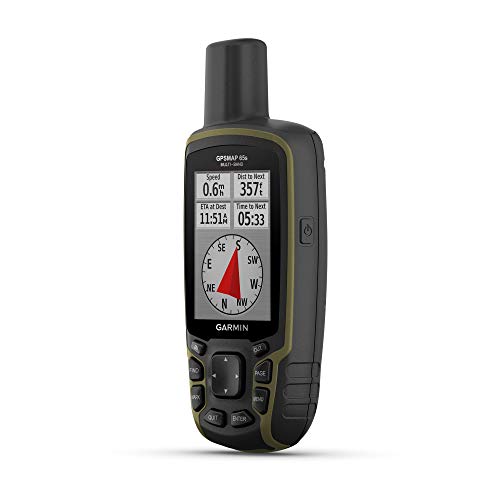
Offering impressive multi-band technology and expanded global navigation satellite systems, the Garmin GPSMAP 65s is ideal for outdoor enthusiasts seeking reliable accuracy in challenging environments. With a 2.6” sunlight-readable color display, it boasts routable TopoActive mapping and a federal public land map, perfect for your adventures. The integrated 3-axis compass and barometric altimeter enhance your navigation capabilities, while wireless connectivity through BLUETOOTH® and ANT+® keeps you connected. Compatible with the Garmin Explore app, you can easily manage tracks and routes. Weighing just 7.7 ounces, it’s lightweight and ready for hiking, camping, or any exploration.
Best For: Outdoor enthusiasts seeking reliable navigation and mapping capabilities in challenging environments.
Pros:
- Impressive multi-band technology ensures optimal accuracy in various terrains.
- Lightweight design at 7.7 ounces makes it easy to carry during outdoor activities.
- Routable TopoActive mapping and federal public land map provide extensive navigation options.
Cons:
- Requires 2 AA batteries, which may need frequent replacement during extended trips.
- Smartphone required for full functionality with the Garmin Explore app, limiting standalone use.
- Smaller display size (2.6 inches) may be less user-friendly for some users compared to larger GPS units.
Garmin eTrex SE GPS Handheld Navigator

The Garmin eTrex SE GPS Handheld Navigator stands out as an essential tool for avid hunters and outdoor enthusiasts who need reliable navigation in diverse conditions. With a 2.2” high-resolution display, you can easily read maps even in bright sunlight. Its digital compass guarantees accurate heading, even when you’re stationary. Enjoy impressive battery life—168 hours in standard mode and up to 1,800 hours in expedition mode—powered by two AA batteries. Plus, with multi-GNSS support, you’ll benefit from enhanced tracking. It’s also water-resistant (IPX7), making it durable for any weather. Pair it with the Garmin Explore app for added features and updates.
Best For: The Garmin eTrex SE GPS Handheld Navigator is best for avid hunters and outdoor enthusiasts seeking reliable navigation in diverse weather conditions.
Pros:
- High-resolution 2.2” display for easy reading in bright sunlight.
- Long battery life of up to 1,800 hours in expedition mode.
- Multi-GNSS support enhances tracking capabilities in challenging environments.
Cons:
- Requires two AA batteries, which are not included.
- Limited display size may not suit those who prefer larger screens.
- Some advanced features may require pairing with the Garmin Explore app.
A6 Handheld GPS for Hiking

For avid hikers seeking reliability on rugged trails, the A6 Handheld GPS for Hiking stands out with its impressive 20-hour battery life. This rugged, waterproof navigator boasts a bright 2.4″ sunlight-readable display, ensuring you can see it in any weather. With multi-GNSS support, it offers positional accuracy of less than 5 feet, essential for challenging terrains. You’ll love its waypoint and track navigation features, allowing you to save up to 1,000 waypoints and record your routes. Plus, the side non-slip design and physical buttons make it easy to use, even with gloves on. Get ready for your next adventure!
Best For: Avid hikers looking for a reliable and accurate GPS navigator for rugged trails and challenging terrains.
Pros:
- Impressive 20-hour battery life allows for extended hiking excursions without the need for frequent recharging.
- Multi-GNSS support ensures superior positional accuracy, critical for navigating in difficult environments.
- User-friendly design with a bright, sunlight-readable display and physical buttons enhances usability in various weather conditions.
Cons:
- No pre-loaded maps, requiring users to find satellite signals and potentially limiting usability in unfamiliar areas.
- Limited display size at 2.4 inches may make it difficult to view detailed navigation information at a glance.
- Rechargeable battery may require access to a power source for longer trips, which can be a limitation for multi-day hikes.
Handheld GPS Navigator for Hiking

When you’re traversing rugged trails, a handheld GPS navigator designed specifically for hiking can make all the difference. These compact, lightweight devices are rugged and waterproof, featuring a 3.2″ sunlight-readable screen for easy visibility. With multi-GNSS support, you’ll enjoy precise location accuracy within 6 feet, aided by a 3-axis compass and barometric altimeter. The rechargeable battery lasts up to 36 hours, and recharging is simple with a USB-C cable. Plus, the water-resistant design guarantees reliability in any weather. Preloaded with USA Topo maps and 32 GB of internal memory, you’ll always be prepared for your next adventure.
Best For: Outdoor enthusiasts and hikers looking for a reliable, accurate navigation tool to enhance their trekking experiences.
Pros:
- Compact and lightweight design makes it easy to carry on long hikes.
- Multi-GNSS support ensures superior positional accuracy even in challenging environments.
- Preloaded USA Topo maps and 32 GB of internal memory allow for extensive mapping options.
Cons:
- Limited battery life of 36 hours may require frequent recharging on longer trips.
- The 3.2″ screen size may be small for users who prefer larger displays for navigation.
- Some users may find the initial setup and operation complex if they are not tech-savvy.
Garmin GPSMAP 64sx Handheld GPS

Designed for outdoor enthusiasts, the Garmin GPSMAP 64sx Handheld GPS stands out with its rugged, water-resistant build, making it ideal for hunting and hiking in challenging environments. You’ll appreciate its 2.6” sunlight-readable color display, ensuring visibility even in bright conditions. With a high-sensitivity receiver and quad helix antenna, you’ll enjoy reliable navigation through GPS, GLONASS, and Galileo systems. Preloaded TopoActive maps cover the U.S. and Australia, perfect for exploring trails. Plus, with Bluetooth and ANT+ connectivity, sharing data is a breeze. And with a battery life of up to 16 hours, you won’t get lost easily on your adventures.
Best For: Outdoor enthusiasts looking for a reliable and rugged GPS device for hiking and hunting adventures.
Pros:
- Rugged and water-resistant design suitable for challenging outdoor conditions.
- High-sensitivity receiver with multi-GNSS support ensures reliable navigation.
- Preloaded TopoActive maps for the U.S. and Australia facilitate exploration of routes and trails.
Cons:
- Limited battery life of up to 16 hours may require extra planning for extended trips.
- Button-operated interface may not be as user-friendly for those accustomed to touch screens.
- Size and weight may be less convenient for some users compared to smaller GPS devices.
Garmin GPSMAP 67i Rugged GPS Handheld with inReach Satellite Technology

Hunters seeking a reliable companion in the wild will appreciate the Garmin GPSMAP 67i, which combines rugged durability with advanced inReach satellite technology. Its large 3” sunlight-readable color display makes navigation effortless, while preloaded TopoActive maps guide you through any terrain. With two-way messaging and global tracking through the Iridium satellite network, you can stay connected even in remote areas. The internal battery lasts up to 165 hours in tracking mode, ensuring you won’t lose your way. Plus, smartphone integration gives you access to weather forecasts and trip planning through the Garmin Explore app, making it an essential tool for every outdoor adventure.
Best For: Outdoor enthusiasts and hunters who need a reliable GPS device with satellite communication capabilities in remote areas.
Pros:
- Large, sunlight-readable display for easy navigation in various lighting conditions.
- Two-way messaging and SOS functionality ensure safety and connectivity in emergencies.
- Long battery life with up to 425 hours in expedition mode, ideal for extended trips.
Cons:
- Requires an active subscription for full functionality of satellite communication features.
- Initial setup and learning curve may be challenging for some users unfamiliar with advanced GPS devices.
- Higher price point compared to basic GPS units without satellite capabilities.
Factors to Consider When Choosing a Hunting GPS Handheld
When choosing a hunting GPS handheld, you’ll want to take into account several important factors. Display visibility in sunlight can make a big difference in usability, while battery life duration guarantees you won’t get stranded. You’ll also want to evaluate navigation accuracy features, mapping options, and the device’s weight for portability.
Display Visibility in Sunlight
A bright display is essential for any hunting GPS handheld, especially in sunny conditions where visibility can be a challenge. Look for a sunlight-readable display that enables you to easily view GPS information in bright light. Higher pixel resolutions, like 240 x 320 pixels, enhance readability by providing clearer images and text. Screens designed to reduce glare will greatly improve visibility, making navigation data easier to interpret. A compact size of around 2.2 to 2.6 inches strikes the right balance between portability and screen real estate, ensuring you can access essential information without hassle. Additionally, opt for multi-color displays, as they convey different types of information more effectively than monochrome screens, especially in varying lighting conditions.
Battery Life Duration
Choosing a hunting GPS handheld means considering battery life duration as a key factor in your decision-making. Many devices can last anywhere from 20 hours to over 400 hours, depending on the mode you choose. If you opt for devices powered by AA batteries, expect around 25 hours in GPS mode, so plan for replacements on extended trips. On the other hand, rechargeable lithium batteries can last up to 165 hours in tracking mode, perfect for multi-day hunts. Be mindful that features like wireless connectivity and backlighting can drain the battery faster. It’s wise to select devices with field-replaceable batteries or power-saving modes to extend usage during prolonged adventures. Prioritize battery life to guarantee you stay on track.
Navigation Accuracy Features
Steering through the wilderness effectively is crucial for any hunter, so paying attention to wayfinding accuracy features in a handheld GPS device is essential. Look for devices that support multi-GNSS, including GPS, GLONASS, Galileo, and BeiDou, as they enhance tracking accuracy and reduce signal loss in tough environments. Multi-band technology is a must for maneuvering steep terrains or dense foliage. Advanced features like a 3-axis compass and barometric altimeter help you maintain accurate headings and elevation. Additionally, high-sensitivity receivers guarantee quick satellite signal acquisition, providing reliable location fixes. Finally, routable topographic maps help you traverse trails and terrain, further minimizing the risk of getting lost during your hunting adventures.
Mapping Options Available
When selecting a handheld GPS device for hunting, several mapping options can greatly enhance your outdoor experience. Look for devices preloaded with TopoActive maps, offering detailed routable roads and trails perfect for your hunting trips. It’s essential to choose a unit that supports multiple global navigation satellite systems (GNSS) for improved accuracy in tough environments like dense forests or mountains. Make sure the GPS allows for downloading additional maps, so you can customize and expand your options as needed. Also, evaluate the display size and readability, particularly in bright sunlight, to guarantee navigation remains clear during your excursions. Finally, consider features like a barometric altimeter and a 3-axis compass to enhance navigation in rugged terrains.
Weight and Portability
Weight and portability play an essential role in selecting a handheld GPS for hunting, especially if you plan to trek for long hours. A lightweight device, typically weighing between 5 to 8 ounces, makes it easier to carry on lengthy trips. Look for compact designs that fit neatly into your pockets or backpacks, enhancing your mobility. While rugged construction is important for durability, many devices achieve this without adding significant weight. Additionally, consider battery life; models that use multiple AA batteries might be bulkier than rechargeable options. Finally, an ergonomic design enhances comfort and usability, ensuring that lighter devices feel good in your hands, even during extended use. Choose wisely to enjoy your hunting experience fully!
Durability and Weather Resistance
Choosing a hunting GPS handheld that can endure the rigors of the outdoors is essential for a successful trip. Look for a device designed with rugged construction to withstand harsh conditions and impacts during use. A waterproof rating of IPX7 or higher is imperative, ensuring your GPS can handle splashes and immersion without failing. Additionally, consider its temperature operating range; it should perform well in both high and low temperatures typical of hunting seasons. Dust resistance is another important feature to protect the internal components from dirt and debris. Finally, select a lightweight and compact unit, making it easier to carry during long hunts while still providing robust protection against the elements. Your gear should be as tough as the terrain you’re traversing.
Connectivity and Compatibility Options
While hunting GPS devices can vary in features, connectivity and compatibility options play an essential role in maximizing their utility. Look for devices that offer wireless options like Bluetooth and ANT+ for easy data sharing and access to mobile apps, enhancing your hunting experience. Confirm compatibility with mapping software to manage tracks, routes, and waypoints effectively. Supporting multiple global navigation satellite systems (GNSS) like GPS, GLONASS, Galileo, and BeiDou can improve tracking accuracy in diverse environments. Additionally, check for features that allow automatic updates and geocaching cache updates when paired with compatible apps. Finally, evaluate the device’s ability to connect to the internet for accessing weather forecasts and premium mapping content through subscription services.