Manual camera macro rails give macro photographers controlled, repeatable movement for focusing, close-up composition, and focus stacking. The right rail can make tiny adjustments smoother while keeping your camera and subject stable.
We compared these 10 options by travel, adjustment design, mounting compatibility, construction, and practical features to help you choose a rail that matches your camera setup and shooting style.
Best 10 Manual Camera Macro Rails Picks for 2026
Best Overall
NiSi NM-180S Macro Focusing Rail

- 1.25mm movements per rotation and 160mm range
- 360-degree rotating clamp
- Arca-compatible with multiple mounting threads
Best For: Flexible macro setups and precise close-up positioning
Simple Heavy-Duty Pick
Promaster FC-1 Macro Focusing Rail

- 2 kg maximum weight recommendation
- Designed for cameras
- Straightforward macro rail option
Best For: Basic setups where stated load capacity is important
Best for Focus Stacking
Haoge FM-160 Wormdrive Macro Rail

- 115mm wormdrive-controlled travel
- 1mm laser-engraved scales
- Arca-compatible and tripod-mountable
Best For: Measured macro movements and focus stacking
Best Long-Rail Design
Desmond DLR-2502B Double Macro Rail

- 250mm double-rail format
- All-aluminum construction
- Bubble level and precision decimal scale
Best For: Long travel and alignment-conscious Arca setups
Best All-Around 4-Way Rail
NEEWER 4-Way Macro Focusing Rail

- Four-direction manual adjustment
- Supports cameras up to 2.5 kg
- Quick-release plate and tripod mounting
Best For: Macro photographers needing flexible four-way positioning
Best Lightweight Value
Aluminum Alloy Macro Focus Rail Slider

- Aluminum and magnesium alloy build
- Geared slide with dual rulers
- Up to 4 inches of longitudinal travel
Best For: Close-up work requiring measured tripod-mounted movement
Best Premium Precision Rail
SIRUI MS18 Macro Focusing Rail

- Quick adjustment and fine control
- 360-degree rotating head
- Stackable for four-way adjustment
Best For: Close-up and product photographers using Arca-style gear
Best Precision Pick

- Fast 14mm-per-turn threaded adjustment
- Rotating top module with damping and lock
- Supports up to 17.6 pounds
Best For: Serious macro photographers seeking stable, precise positioning
Best Long-Travel Option
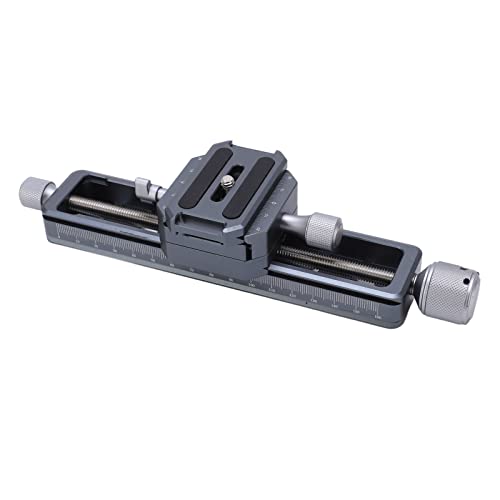
- 16cm effective working stroke
- Double-sided 38mm Arca compatibility
- 5kg capacity with hollow aluminum construction
Best For: Shooters wanting extended travel and flexible Arca mounting
Best Budget Two-Way Rail

- Geared two-way rack-and-pinion movement
- 80mm left-right adjustment range
- Can combine two units for four-way movement
Best For: Beginners using lightweight cameras for close-up work
Best Overall – NiSi NM-180S Macro Focusing Rail
The NiSi NM-180S is a versatile choice for photographers comparing manual camera macro rails. Its 160mm adjustment range, 1.25mm movement per rotation, and 360-degree rotating clamp provide precise positioning for close-up work.
Best For: Photographers who want broad adjustment range, flexible camera orientation, and multiple mounting options.
Pros:
- Fine 1.25mm movements per rotation with 160mm of adjustment.
- 360-degree rotating clamp allows camera repositioning without removing the rail mount.
- Arca-Swiss compatibility, long quick-release plate, and 1/4-inch and 3/8-inch mounting holes.
- CNC-machined aluminum construction with a scratch-resistant finish.
Cons:
- Its relatively feature-rich design may be more than needed for basic macro positioning.
- The supplied notes do not specify a maximum supported camera weight.
Choose the NM-180S when flexibility matters as much as fine adjustment. The rotating clamp and broad mounting compatibility make it a strong all-around manual camera macro rail.
Simple Heavy-Duty Pick – Promaster FC-1 Macro Focusing Rail
The Promaster FC-1 is a straightforward option among manual camera macro rails. Its listed 2 kg maximum weight recommendation makes it suitable for photographers seeking a basic rail with a comparatively substantial stated load capacity.
Best For: Users who prioritize a simple macro rail with a clearly listed 2 kg maximum weight recommendation.
Pros:
- Maximum weight recommendation of 2 kg.
- Designed for camera compatibility.
- Simple, focused product design for macro rail use.
Cons:
- The supplied notes provide no adjustment range or movement-per-turn specification.
- No detailed mounting, scale, or construction features are listed.
- The product details identify the brand as KIWIFOTOS, while the title identifies it as Promaster.
The FC-1 may appeal to buyers who want a no-frills focusing rail and value a stated load recommendation. Review the mounting and adjustment details carefully before choosing it for a specialized setup.
Best for Focus Stacking – Haoge FM-160 Wormdrive Macro Rail
The Haoge FM-160 is one of the more precise manual camera macro rails for controlled close-up adjustments. Its wormdrive provides 115mm of travel, with each full adjustment-screw rotation producing a 4mm stroke.
Best For: Macro photographers and focus-stacking users who want measured, repeatable front-to-back movement.
Pros:
- 115mm of front-to-back movement controlled by an adjustment knob.
- Laser-engraved 1mm reference scales on both sides.
- Integrated Arca-type clamp, dovetail groove, and 1/4-inch-20 tripod threads.
- Two damping-control screws and a 400g listed weight.
Cons:
- The 115mm travel is shorter than the NiSi NM-180S range listed above.
- The listed maximum weight recommendation is only 14.1 ounces, so heavier setups require caution.
- It is not water resistant.
With its reference scales, damping controls, and wormdrive adjustment, the FM-160 is well suited to repeatable focus-stacking movements. Its listed load recommendation makes checking camera-and-lens weight especially important.
Best Long-Rail Design – Desmond DLR-2502B Double Macro Rail
DLR-2502B Desmond 250mm Double Macro Rail Arca-Swiss Compatible with Bubble Level
Check Price On AmazonThe Desmond DLR-2502B takes a long-rail approach to manual camera macro rails, offering a 250mm double-rail format. Its all-aluminum construction, Arca compatibility, bubble level, and precision decimal scale support careful alignment and positioning.
Best For: Photographers who need a long 250mm rail and want built-in alignment aids for Arca-style setups.
Pros:
- 250mm double macro rail provides an extended platform.
- All-metal aluminum construction with no rubber or plastic parts.
- Compatible with Arca-style clamps, including RRS lever clamps.
- Includes a bubble level, precision decimal scale, mounting screws, safety screws, and Allen wrenches.
Cons:
- The supplied notes do not describe the adjustment mechanism or movement precision.
- Its long format may be less convenient than a shorter rail for compact field kits.
- The listed maximum weight recommendation is 205g, limiting heavier camera setups.
The DLR-2502B is worth considering when rail length and all-metal construction take priority. However, the low listed weight recommendation should be checked carefully against the intended camera and lens combination.
Best All-Around 4-Way Rail – NEEWER 4-Way Macro Focusing Rail
The NEEWER 4-Way Macro Focusing Rail is a practical choice for photographers who need controlled camera positioning. Its four-direction manual movement and numeric scales make it a versatile option for manual camera macro rails used in close-ups, macro photography, and time-lapse work.
Best For: Macro photographers who want four-way positioning, tripod compatibility, and a quick-release camera mount.
Pros:
- Provides left, right, forward, and backward adjustment.
- Large adjustment knobs and numeric scales support precise positioning.
- Aluminum construction weighs 1.3 pounds while supporting cameras up to 5.5 pounds.
- Includes a quick-release plate, 1/4-inch screw, and two tripod connection options.
Cons:
- Both horizontal and vertical adjustment knobs need to be secured correctly for stable operation.
- It is not water resistant.
Choose this rail when flexible four-way control matters more than the lightest possible setup. Its stated 2.5 kg capacity and familiar 1/4-inch mounting make it suitable for many DSLR and mirrorless camera systems.
Best Lightweight Value – Aluminum Alloy Macro Focus Rail Slider
Omquot Lightweight Aluminum Alloy Macro Focus Rail Slider Close-Up Slider for SLR Cameras
Check Price On AmazonThis lightweight aluminum and magnesium alloy slider offers a straightforward approach to manual camera macro rails. Its geared metal slide, dual rulers, and adjustable locking device are designed for controlled close-up camera movements on a tripod.
Best For: Close-up photographers seeking a compact manual slider with measured lateral and longitudinal travel.
Pros:
- Aluminum and magnesium alloy construction is designed for low weight and sturdiness.
- Geared metal transmission supports precise movement.
- Dual rulers help with repeatable displacement adjustments.
- Offers up to 2 inches of lateral motion and 4 inches of longitudinal stroke.
Cons:
- The supplied notes do not specify the rail’s weight or dimensions.
- Compatibility information is limited to cameras and a 1/4-inch screw hole.
This is a sensible option if you want measured slider movement without a more elaborate feature set. Verify your camera and tripod requirements before buying, especially if you need a particular quick-release standard.
Best Premium Precision Rail – SIRUI MS18 Macro Focusing Rail
The SIRUI MS18 is a feature-rich choice among manual camera macro rails, combining fine focus adjustment with a quick adjustment button and an Arca-Swiss quick-release plate. Its rotating head, detachable feet, and stacking capability make it adaptable for close-up and product photography.
Best For: Photographers who want Arca-style mounting, angle adjustment, and the option to build a four-way rail system.
Pros:
- Quick adjustment button enables faster repositioning.
- 360-degree rotating head supports varied camera angles.
- Two rails can be stacked for four-way adjustment.
- Detachable feet allow tabletop use or direct tripod mounting.
Cons:
- The rail uses Arca-style mounting, which may require compatible accessories.
- The supplied notes identify it as not water resistant.
Consider the MS18 when modular mounting and shooting flexibility are priorities. Its listed 10 kg maximum weight recommendation is substantial, while the rotating head and removable feet broaden its use beyond a basic linear macro slider.
Best Precision Pick – Fotopro FT-100 PRO Macro Rail
For photographers comparing manual camera macro rails, the Fotopro FT-100 PRO stands out for its precise, fast adjustment and sturdy construction. Its multi-headed threaded screw moves 14mm per turn, while the rotating top module, damping, and locking knob help refine composition with a mounted camera or telephoto lens.
Best For: Serious macro photographers who want stable, highly adjustable positioning and broad camera compatibility.
Pros:
- CNC-machined aluminum construction with stainless steel hardware and durable copper sliding parts.
- Fast, smooth crank adjustment with a 14mm-per-turn movement rate.
- 360-degree rotating top module, level, damping, and locking knob support precise composition.
- Removable feet allow stable desktop use without a tripod, and the rail supports up to 17.6 pounds.
Cons:
- Its advanced construction and features may be more than casual close-up shooters need.
- The rail is not water resistant.
With its strong load rating, quick-release design, and three-dimensional adjustment options, the FT-100 PRO is a capable choice when controlled, repeatable macro positioning matters most.
Best Long-Travel Option – NEZHSHIUY 16cm Macro Rail
The NEZHSHIUY macro focusing rail is a practical option for manual camera macro rails when you need generous travel and flexible mounting. It provides a 16cm effective stroke, double-sided Arca compatibility, and rotary or foldable-handle operation for close-up positioning.
Best For: Macro shooters who want long adjustment travel, Arca mounting, and a portable aluminum design.
Pros:
- 16cm effective working stroke gives plenty of room for creative close-up composition.
- Double-sided 38mm Arca mounts can attach directly to a compatible ball head.
- Supports up to 5kg while using a hollow aluminum-alloy design to reduce weight.
- Four detachable nails provide stable use on desktops or floors.
Cons:
- Its listed compatibility information is limited, with compatible devices identified as laptops.
- The 578g gross weight is less travel-friendly than lighter compact rails.
- A 90-day manufacturer warranty is relatively short.
The combination of long travel, dual Arca mounting, and removable support nails makes this rail versatile, particularly for photographers who value range and mounting flexibility over the smallest possible setup.
Best Budget Two-Way Rail – EXMAX LP-01 Macro Slider
The EXMAX LP-01 is a straightforward choice among manual camera macro rails, using a geared rack-and-pinion drive for controlled two-way movement. Its rubberized camera surface, locking knobs, and 80mm of left-right travel make it useful for basic close-up focusing with cameras using a standard 1/4-inch socket.
Best For: Beginners and budget-conscious macro photographers who need simple two-axis adjustment.
Pros:
- Rack-and-pinion movement provides fine, repeatable focus adjustments.
- Rubber top surface helps protect the camera and reduce sliding.
- Two 1/4-inch male screws allow use as a flash bracket, while female threads support tripod mounting.
- Two units can be combined into a four-direction macro slider.
Cons:
- The 80mm travel is shorter than the 16cm stroke offered by some competing rails.
- The listed maximum weight recommendation is only 7.04 ounces.
- It lacks the more extensive rotating and support features found on higher-end rails.
Compact and versatile, the LP-01 is best suited to lightweight camera setups and photographers who want an inexpensive way to make precise horizontal and vertical focus adjustments.
How We Picked the Best Manual Camera Macro Rails
We focused on the features that matter most during real macro work: adjustment precision, usable travel, rigidity, mounting flexibility, and ease of setup. Rails with worm drives or rack mechanisms can offer finer control than basic sliding designs, while longer rails may provide more framing flexibility but add weight and bulk.
We also considered tripod and Arca-Swiss compatibility, quick-release plates, bubble levels, rotating clamps, and support features. These details affect how quickly you can reposition a camera and how securely the system stays aligned during close-up shooting.
Quick Comparison
| Rail Type | Best For | What to Check |
|---|---|---|
| Single-axis rail | Simple focus and composition adjustments | Travel length and drive smoothness |
| Four-way rail | Multi-direction positioning | Platform stability and control layout |
| Double rail | Longer travel and heavier setups | Rigidity, weight, and tripod support |
| Worm-drive rail | Fine focus-stacking adjustments | Backlash and adjustment range |
Key Buying Factors for Manual Camera Macro Rails
Adjustment Precision
Fine-thread or worm-drive mechanisms are useful when stacking images or working at high magnification. Look for smooth movement with minimal play. A rail that shifts abruptly can make it difficult to maintain consistent focus intervals.
Travel and Movement
Shorter rails are compact and often easier to pack, while longer models provide more room to move the camera toward or away from a subject. Confirm the listed effective stroke rather than judging by the rail’s overall length.
Mounting Compatibility
Check whether the rail fits your tripod head, camera plate, and lens support system. Arca-Swiss compatibility can simplify changes between a rail and tripod, but dimensions and clamp orientation still vary. Verify screw sizes and included plates before buying.
Stability and Load Capacity
Macro magnification makes small vibrations noticeable. Prefer rigid aluminum construction, a secure locking mechanism, and a broad mounting base. Heavier camera bodies or long macro lenses may benefit from double-rail designs or additional lens support.
Workflow Features
Quick-release plates, rotating clamps, bubble levels, and flash-support points can speed up setup. These extras are valuable when you frequently change orientation or shoot outdoors, but they should not outweigh poor movement control or inadequate rigidity.
Who Should Buy Which Manual Camera Macro Rails?
Choose a compact single-axis rail if you mainly need straightforward front-to-back focusing and want a lightweight kit. A worm-drive model is better for careful focus stacking and repeatable micro-adjustments. Select a four-way rail when you need to reposition the camera laterally as well as change focus distance.
Photographers using heavier bodies, longer lenses, or studio stacking setups should consider a longer double-rail design with strong tripod mounting. If you switch frequently between portrait and landscape orientations, prioritize a model with flexible clamps or a rotating mounting system. Before purchasing, compare the rail’s travel, mounting standard, load support, and packed size with your existing macro setup.