Focus stacking rewards careful movement: shifting the camera in controlled increments lets you combine multiple focus planes into one exceptionally sharp macro image. The right macro rail makes that process easier, more repeatable, and less frustrating.
We compare 10 camera macro rails for focus stacking, including worm-drive and multi-axis designs, quick-release systems, Arca-Swiss options, and compact close-up sliders. Use the guide below to match rail precision and features to your camera, lens, and shooting style.
Best 10 Camera Macro Rails for Focus Stacking Picks for 2026
Best Precision Wormdrive Rail

- 115 mm of controlled travel
- 1 mm engraved reference scales
- Arca-type and tripod mounting
Best For: Repeatable macro focus-stacking adjustments
Best Simple Stable Slider

- Precise, controlled camera movement
- Quick-release setup
- Broad camera and lens compatibility
Best For: Stable close-up positioning with easy setup
Best Versatile Four-Way Rail

- 360-degree rotating head
- Stackable for four-way adjustment
- Detachable feet and Arca-style mounting
Best For: Flexible macro and product-shooting setups
Best Dual-Accuracy Slide Rail

- Two specified accuracy levels
- Arca-Swiss-compatible clamp
- Three-bearing movement system
Best For: Highly precise insect macro focus stacking
Best All-Around 4-Way Rail
NEEWER 4-Way Macro Focusing Rail

- Four-way movement with numeric scales
- Supports cameras up to 2.5kg
- Quick-release plate and tripod mounting
Best For: Versatile macro and focus-stacking setups
Best Arca-Compatible Option
Haoge MFR-180 Macro Focusing Rail
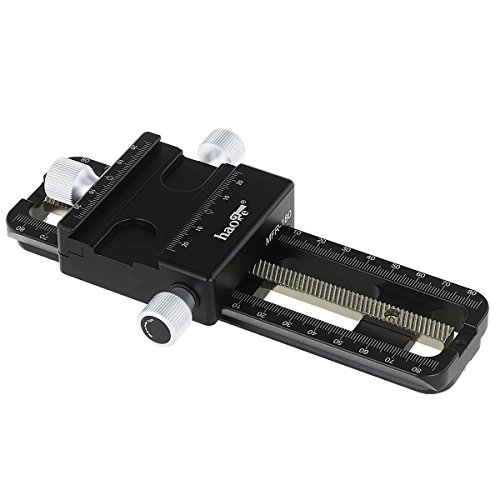
- Integrated Arca-type quick-release clamp
- Supports precise incremental alignment
- Also works as a nodal panorama slide
Best For: Arca-based macro and lightweight focus-stacking setups
Best Budget Two-Way Rail
EXMAX 16cm 2-Way Macro Focus Rail

- Geared rack-and-pinion adjustment
- 80mm of stated travel
- Two rails can form a four-way slider
Best For: Lightweight, budget-conscious macro setups
Precision Pick
NiSi NM-200S Macro Focusing Rail

- 1mm movements per rotation and 180mm travel
- Quick-position button for faster setup
- 360-degree rotating clamp with Arca compatibility
Best For: Macro photographers needing flexible positioning and extended travel
Fine-Control Choice

- 0.05mm micrometer adjustment for precise stacking
- 160mm range with quick-adjustment button
- Detachable feet and integrated Arca plate
Best For: Focus stacking and close-up work requiring fine control
Compact Workhorse
NiSi NM-180S Macro Focusing Rail

- 1.25mm movements per rotation with 160mm travel
- 360-degree rotating clamp and Arca compatibility
- CNC-machined aluminum with scratch-resistant finish
Best For: Durable everyday macro and field photography setups
Best Precision Wormdrive Rail – Haoge FM-160
For photographers comparing camera macro rails for focus stacking, the Haoge FM-160 stands out for controlled, incremental movement. Its wormdrive adjustment, engraved scale, and Arca-type mounting options make it well suited to close-up alignment.
Best For: Macro photographers who want fine, repeatable front-to-back adjustments for focus stacking and close-up work.
Pros:
- Provides up to 115 mm of front-to-back travel with a fine adjustment screw.
- Laser-engraved 1 mm reference scales help track movement.
- Includes an integrated Arca-type clamp and 1/4-20 tripod threads.
- At about 400 g, it is relatively portable for nature photography.
Cons:
- Its maximum recommended weight is listed as 14.1 ounces, limiting heavier setups.
- It is not water resistant.
The FM-160 is a practical choice when precise, measured movement matters more than rapid repositioning. It can also serve as a nodal slide for panorama shooting.
Best Simple Stable Slider – ProMaster MR1
The ProMaster MR1 is a straightforward option for photographers seeking camera macro rails for focus stacking. It emphasizes stable, smooth movement and quick-release setup, helping you position a camera carefully for detailed close-up compositions.
Best For: Macro photographers who prioritize stable positioning and convenient setup across different camera and lens combinations.
Pros:
- Designed for precise, stable camera movement and fine adjustments.
- Quick-release system helps speed up setup and repositioning.
- Provides smooth, controlled movement to help minimize unwanted shifts.
- Compatible with a wide range of camera models and lens setups.
Cons:
- The supplied notes do not specify travel length or a detailed measurement scale.
- At 16 ounces, it is heavier than some compact macro rails.
- It is not water resistant.
The MR1 makes sense for users who want a durable, uncomplicated focusing rail rather than a feature-heavy positioning stage. Its quick-release design is useful when changing setups regularly.
Best Versatile Four-Way Rail – SIRUI MS18
Among camera macro rails for focus stacking, the SIRUI MS18 offers especially flexible positioning. Its quick-adjustment control, rotating head, Arca-style slider, and stackable design support both precise focus work and varied shooting angles.
Best For: Macro and product photographers who need adjustable angles, quick repositioning, and the option to build a four-way rail setup.
Pros:
- One-key quick adjustment supports faster repositioning.
- 360-degree rotating head enables flexible camera angles.
- Two rails can be stacked for four-way camera adjustment.
- Detachable feet allow tabletop use or direct tripod mounting.
Cons:
- Its 440 g weight may be less appealing for lightweight field kits.
- The rail is not water resistant.
- Stacking two rails adds complexity and additional equipment.
The MS18 is a strong fit when a single-axis slider feels restrictive. Its modular mounting and angle adjustments make it particularly adaptable for tabletop, product, and close-up work.
Best Dual-Accuracy Slide Rail – SWEBO S102082
Swebo S102082 2-Accuracy Macro Focusing Slide Rail,Focus Stacking,Insect Macro Photography
Check Price On AmazonThe SWEBO S102082 is aimed at photographers who want highly fine-grained control from camera macro rails for focus stacking. It includes two accuracy slide rails, Arca-Swiss compatibility, and bearing-supported movement for detailed insect and close-up photography.
Best For: Focus-stacking users who value very fine adjustment options for insect macro photography and other precision close-ups.
Pros:
- Includes slide rails specified at 0.04 mm and 0.01 mm accuracy.
- Arca-Swiss-compatible quick-release clamp supports compatible tripod heads.
- Uses three bearings, including two miniature thrust bearings.
- Offers five 1/4-inch screw holes plus a large knurled knob and crank.
Cons:
- At 623 g, it is relatively heavy for a macro rail.
- The listed maximum weight recommendation is 577 g.
- The supplied notes do not describe water resistance.
The S102082 is built around precision rather than portability. Its dual accuracy specifications and bearing-supported design make it worth considering for controlled, stationary focus-stacking work.
Best All-Around 4-Way Rail – NEEWER 4-Way Macro Focusing Rail
For photographers comparing camera macro rails for focus stacking, the NEEWER 4-Way Macro Focusing Rail offers independent left-right and forward-backward positioning. Its numeric scales and large adjustment knobs help you make repeatable camera movements for macro photography, close-ups, and time-lapse work.
Best For: Macro photographers who want four-direction positioning, a quick-release camera plate, and tripod compatibility.
Pros:
- Four-way movement supports precise positioning along two axes.
- Aluminum-alloy construction supports cameras up to 2.5kg while weighing 1.3lb.
- Quick-release plate includes a 1/4-inch screw and silicone protective pad.
- Connects to a tripod or video head through a 1/4-inch-20 socket or dovetails.
Cons:
- The horizontal adjustment knob should be secured when adjusting vertically, and vice versa.
- It is not water resistant.
The NEEWER is a versatile choice when your focus-stacking setup requires more than simple front-to-back movement. Its four-way layout and relatively high stated load capacity make it suitable for both studio and outdoor macro setups.
Best Arca-Compatible Option – Haoge MFR-180 Macro Focusing Rail
The Haoge MFR-180 is a compact choice among camera macro rails for focus stacking, with a design intended for small, incremental camera alignment. Its integrated Arca-type clamp and dovetail groove can simplify mounting with compatible heads and accessories.
Best For: Macro photographers using Arca-type equipment who need a rail for focus stacking, close-ups, or nodal panorama work.
Pros:
- Designed for precise incremental adjustments in macro and close-up photography.
- Built-in Arca-type compatible quick-release clamp.
- Arca-type dovetail groove supports compatible heads and accessories.
- Can also serve as a nodal slide for panorama shooting.
Cons:
- Its stated maximum weight recommendation is 14.1 ounces, limiting camera and lens combinations.
- Compatibility benefits depend on having Arca-type heads or accessories.
- It is not water resistant.
The MFR-180 stands out for users already invested in an Arca-style mounting system. Check your camera-and-lens weight carefully before choosing it, since its listed load recommendation is lower than the other rails in this roundup.
Best Budget Two-Way Rail – EXMAX 16cm 2-Way Macro Focus Rail
The EXMAX 16cm rail is a straightforward option for photographers seeking camera macro rails for focus stacking. Its geared rack-and-pinion drive provides fine front-to-back adjustment, while the marked 80mm travel range helps with repeatable close-up positioning.
Best For: Lightweight DSLR or digital-camera macro setups needing precise two-way adjustment and a low-profile rail.
Pros:
- Rack-and-pinion movement enables fine focusing adjustments.
- Offers 80mm/3.1 inches of left-right travel in two-way positioning.
- Rubber top surface helps protect the camera and increase friction.
- Can be paired with a second unit to create a four-direction slider.
Cons:
- The listed maximum weight recommendation is 7.04 ounces.
- It provides two-way movement rather than four-way adjustment as supplied.
- Its compatibility is based on standard 1/4-inch camera mounting rather than an integrated Arca system.
The EXMAX is best suited to lightweight cameras and simple focus-stacking workflows. Its geared adjustment and optional two-rail configuration add flexibility, but the low listed load recommendation calls for careful attention to your camera and lens weight.
Precision Pick – NiSi NM-200S Macro Focusing Rail
For photographers comparing camera macro rails for focus stacking, the NiSi NM-200S combines 1mm-per-rotation control with a 180mm adjustment range. Its quick-position button, Arca-Swiss compatibility, and rotating clamp make it practical for repeatable close-up setups.
Best For: Macro photographers who want a long adjustment range and flexible camera positioning.
Pros:
- Provides precise 1mm movements per rotation across a 180mm range.
- Quick-position button helps make larger setup adjustments efficiently.
- 360-degree rotating clamp allows camera-orientation changes without removing the mount.
- Supports Arca-type mounting plus 3/8-inch and 1/4-inch screw holes.
Cons:
- The supplied notes do not specify a maximum supported camera weight.
- Its 1mm adjustment increment is less fine than the AstrHori model’s stated 0.05mm micrometer adjustment.
The NM-200S is a versatile choice when you need smooth positioning, broad mounting compatibility, and more travel for macro compositions or focus-stacking workflows.
Fine-Control Choice – AstrHori AH-MGA170 Macro Rail
The AstrHori AH-MGA170 stands out among camera macro rails for focus stacking with a stated 0.05mm micrometer adjustment. It also offers 160mm of travel, a quick-adjustment button, detachable feet, and an integrated Arca quick-release plate.
Best For: Close-up and focus-stacking photographers prioritizing very fine camera-position adjustments.
Pros:
- Micrometer provides fine adjustments of 0.05mm for precise positioning.
- Offers 160mm of adjustment range and 2mm movement per rotation for quicker repositioning.
- Detachable feet support tabletop use or direct tripod mounting.
- All-metal construction uses 6061 alloy and 304 stainless steel components.
Cons:
- Its 2mm movement per rotation is less incremental than the NiSi NM-200S and NM-180S specifications.
- The supplied notes describe it as not water resistant.
Choose this rail if fine incremental control is more important than the smallest coarse adjustment per rotation. Its removable feet also make it adaptable between tabletop and tripod-based macro work.
Compact Workhorse – NiSi NM-180S Macro Focusing Rail
The NiSi NM-180S is a durable option for photographers seeking camera macro rails for focus stacking. It provides 1.25mm movements per rotation, a 160mm adjustment range, 360-degree camera rotation, and multiple tripod-mounting options.
Best For: Macro photographers who want a durable, broadly compatible rail for regular field use.
Pros:
- Offers 1.25mm movements per rotation across a 160mm range.
- 360-degree rotating clamp simplifies camera-orientation changes.
- Arca-Swiss-style clamp, long quick-release plate, and double-dovetail mounting support flexible setups.
- CNC-machined aluminum construction has a corrosion-resistant, scratch-resistant finish.
Cons:
- It has less travel than the NM-200S’s stated 180mm range.
- The supplied notes do not mention a quick-position button.
- Its 1.25mm movement specification is coarser than the AstrHori’s stated 0.05mm micrometer adjustment.
The NM-180S is a sensible all-around rail when durability and mounting flexibility matter. It is especially appealing for photographers who frequently handle their macro equipment in the field.
How We Picked These Camera Macro Rails for Focus Stacking
We focused on the features that matter most when moving a camera through a series of precise focus-stack exposures: adjustment control, rigidity, travel range, mounting options, and ease of setup. The selection includes compact two-way rails for straightforward front-to-back movement, four-way models for more positioning flexibility, and geared or rack-driven designs intended for finer adjustments.
We also considered practical compatibility details, including Arca-Swiss quick-release plates, standard 1/4-inch camera mounting screws, tripod connections, clamp designs, and whether a rail can support a camera and macro lens without excessive flex. Product specifications and included hardware can vary, so verify the listing before ordering.
Quick Comparison
| Rail type | Best suited to | Main advantage |
|---|---|---|
| Two-way or single-axis | Basic focus stacking and close-up work | Simpler setup and lower weight |
| Four-way | Composing and repositioning subjects | Movement in multiple directions |
| Worm-drive or rack-driven | Fine, repeatable focus adjustments | Controlled incremental movement |
| Longer travel rail | Large subjects or wider stacking ranges | More camera movement available |
Key Buying Factors for Camera Macro Rails for Focus Stacking
Adjustment Precision
Fine threads, geared drives, and rack mechanisms generally provide more controlled movement than a simple sliding carriage. For high-magnification stacking, look for a rail that lets you make small, repeatable adjustments without sudden jumps or backlash.
Stability and Load Capacity
A rail must remain rigid when the camera shutter is triggered. Check the construction, carriage fit, locking controls, and stated load support. A long lens or heavier camera body can expose flex that is not obvious with a lightweight setup.
Travel Range and Axis Design
Match the rail’s travel to your subject and magnification. Short rails are portable and often sufficient for tabletop macro work, while longer rails help with deeper focus stacks. Four-way rails add compositional control but may be heavier and more complex.
Mounting Compatibility
Confirm the camera screw size, tripod connection, and quick-release format. Arca-Swiss compatibility can speed up setup, but plate dimensions and clamp security still matter. A rotating clamp or adjustable plate may be useful when switching between horizontal and vertical compositions.
Workflow and Portability
For field photography, prioritize compact dimensions, manageable weight, and fast locking controls. For studio stacking, a heavier rail with a smoother geared adjustment may be preferable to a lighter model.
Who Should Buy Which Camera Macro Rails for Focus Stacking?
Beginners and casual close-up photographers: Choose a straightforward two-way rail that is easy to mount and operate. It can provide the essential front-to-back movement without adding unnecessary complexity.
Dedicated focus-stacking users: A worm-drive or rack-driven rail is usually the better choice when consistent, small increments are more important than minimum weight.
Photographers who frequently recompose: Consider a four-way rail for lateral and front-to-back positioning, especially in studio or tabletop work.
Arca-Swiss tripod users: Prioritize a rail with a secure, compatible quick-release plate and confirm that your existing clamp accepts its dimensions.
Whichever model you choose, use a sturdy tripod, disable distracting movement, and test the rail’s smallest practical increment with your camera and lens. The best rail is the one that stays rigid, fits your mounting system, and gives you repeatable control throughout the stack.