Choosing the right camera macro rail can make close-up photography far easier, especially when precise focus placement matters more than speed. The models in this roundup cover compact sliders, four-way systems, worm-drive adjustments, and rotating clamps.
Use the buying guide below to compare movement, mounting compatibility, stability, and the features that matter most for macro work and focus stacking.
Best 10 Camera Macro Rails Picks for 2026
Reliable 4-Way Control

- Four-way precise movement
- 1.3lb aluminum construction
- Quick release and tripod mounting
Best For: Portable macro and close-up shooting
Heavy-Duty Precision
SUNWAYFOTO MFR-150D Wormdrive Rail
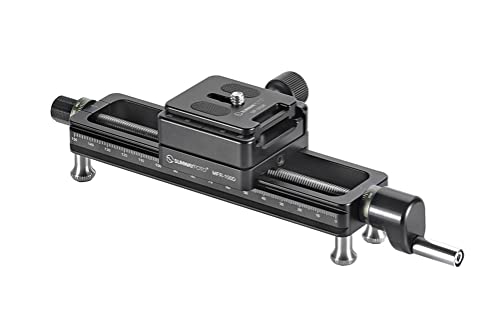
- 15lb maximum load
- Dual cranks with adjustable damping
- Arca/RRS-compatible clamp
Best For: Heavier macro camera and lens setups
Fast, Stable Composition
Fotopro FT-100PRO Macro Slider

- 360-degree rotating top module
- Desktop feet and tripod interfaces
- 8kg maximum load
Best For: Flexible close-up composition and desktop shooting
Extended 4-Axis Positioning

- Dual 100mm sliders
- Four-way motion with swivel
- Arca quick release and 3/8-inch base
Best For: Extended macro positioning and content creation
Best Precision Pick
Haoge FM-160 Wormdrive Macro Rail

- 115mm front-to-back travel
- 4mm movement per knob rotation
- Arca-compatible and about 400g
Best For: Fine macro adjustments and focus stacking
Best Versatile Setup
SIRUI MS18 Macro Focusing Rail

- 360-degree rotating head
- Stackable Arca-style design
- Detachable feet and 3/8" tripod thread
Best For: Flexible close-up and product-shooting setups
Best Load Support
NEEWER GM-MP2 140mm Macro Rail

- 140mm slider range
- Supports up to 2.5kg
- 360-degree rotation and four-way locking
Best For: Long-travel macro and close-up setups
Premium Precision Pick
NiSi NM-180S Macro Focusing Rail

- 1.25mm-per-rotation precision and 160mm travel
- 360-degree rotating clamp for flexible framing
- Arca-compatible with multiple mounting options
Best For: Precise, versatile tripod-based macro setups
Budget Two-Way Option
EXMAX 16cm Macro Focus Rail Slider

- 80mm of two-way left-right movement
- Rack-and-pinion drive for controlled focusing
- Can combine two units into a four-direction slider
Best For: Lightweight close-up and entry-level macro setups
Fine-Adjustment Specialist

- 0.05mm micrometer adjustments for precise positioning
- 160mm travel with quick-adjustment function
- Detachable feet and integrated Arca quick-release plate
Best For: Focus stacking and highly precise macro positioning
Reliable 4-Way Control – NEEWER GM-MP1 Macro Rail
The NEEWER GM-MP1 is a practical choice when shopping for camera macro rails for close-ups, macro photography, or time-lapse work. Its four-way adjustment, numeric scales, and large screw knobs help you position the camera with control, while the quick release plate simplifies setup.
Best For: Macro photographers who want portable four-direction positioning and straightforward tripod compatibility.
Pros:
- Four-way movement supports left, right, forward, and backward adjustments.
- Aluminum construction weighs 1.3 pounds and supports cameras up to 5.5 pounds.
- Quick release plate and 1/4-inch tripod socket make mounting convenient.
Cons:
- Its 2.5kg maximum load is lower than some heavier-duty rails.
- Not water resistant.
With a compact design, silicone-protected camera mounting surface, and two tripod connection methods, the GM-MP1 offers a balanced feature set for everyday macro setups. Follow the adjustment guidance and lock the horizontal or vertical control as appropriate for stable shooting.
Heavy-Duty Precision – SUNWAYFOTO MFR-150D Wormdrive Rail
The SUNWAYFOTO MFR-150D stands out among camera macro rails for photographers who need a high load rating and controlled worm-drive adjustment. Dual cranks, adjustable damping, and an Arca/RRS-compatible bi-directional clamp support precise focus positioning with larger camera setups.
Best For: Macro photographers using heavier cameras, lenses, or accessories who want a robust Arca-compatible rail.
Pros:
- Supports up to 15 pounds, exceeding the capacity of the other listed rails.
- Dual cranks and adjustable tension provide controlled operation.
- Double Arca dovetails and a bi-directional clamp offer flexible mounting.
Cons:
- Its 3.7-inch carriage travel is relatively limited for broader repositioning.
- Uses a screw-knob clamp, which may be slower than a lever-style clamp.
Precision machining from aircraft-grade aluminum keeps the MFR-150D relatively light at 11.9 ounces while delivering a 7kg load rating. Its 1.25mm stage travel per revolution favors deliberate focus adjustments rather than fast, wide movements.
Fast, Stable Composition – Fotopro FT-100PRO Macro Slider
The Fotopro FT-100PRO is a versatile option among camera macro rails, combining quick-release mounting with a rotating top module and independent desktop support. Its multi-headed threaded screw is designed for faster focusing adjustments, while the level and locking controls help maintain precise composition.
Best For: Close-up shooters who want flexible angle control, desktop stability, and support for cameras or lenses up to 8kg.
Pros:
- 360-degree rotating top module helps adjust shooting angles.
- Removable non-slip feet allow stable desktop use without a tripod.
- Supports up to 8kg and includes an Arca universal dovetail slot.
- Two bottom 1/4-inch interfaces support additional heads or equipment.
Cons:
- Not water resistant.
- The feature-rich design may be more than needed for simple macro setups.
With CNC-machined construction, stainless steel hardware, damping, and a locking knob, the FT-100PRO is built for controlled repositioning. Its double macro head supports horizontal and vertical adjustment, making it a flexible choice for demanding close-up compositions.
Extended 4-Axis Positioning – NEEWER GM-MP3 Macro Rail
The NEEWER GM-MP3 expands on the standard camera macro rails concept with dual lead-screw sliders, 4-axis positioning, and a rotating top slider. It is designed for macro photography, close-ups, and time-lapse videos where smooth, repeatable camera movement and flexible framing are important.
Best For: Macro and content creators who need extended adjustment range and Arca-compatible mounting.
Pros:
- Dual sliders provide up to 100mm of movement each and 200mm combined when moved in the same direction.
- Four-way movement plus a 360-degree swivel supports varied camera positions.
- Arca-type quick release and 3/8-inch base thread offer broad mounting compatibility.
Cons:
- At 745g, it is heavier than the GM-MP1.
- Maximum supported camera weight is 2.5kg.
- Not water resistant.
The GM-MP3 is a strong fit when adjustment range matters more than minimal weight. Its aluminum-alloy body, lead screws, positioning lock, and included 3/8-to-1/4-inch adapter give it a flexible setup for studio or outdoor macro work.
Best Precision Pick – Haoge FM-160 Wormdrive Macro Rail
The Haoge FM-160 is a strong choice among camera macro rails when your priority is controlled, incremental positioning. Its worm-drive adjustment provides 115mm of front-to-back travel for close-up photography, focus stacking, or panorama work.
Best For: Macro photographers who need fine focus adjustments and a relatively lightweight rail for field work.
Pros:
- Worm-drive knob provides precise movement, with each full rotation delivering a 4mm stroke.
- Offers 115mm of front-to-back travel with a 1mm laser-engraved scale.
- Includes an Arca-type clamp and dovetail groove, plus 1/4″-20 tripod threads.
- At about 400g, it is practical to carry for outdoor macro photography.
Cons:
- Its maximum weight recommendation is 14.1 ounces, limiting heavier camera setups.
- It provides front-to-back adjustment rather than the four-way configuration available from stacked rails.
Choose the FM-160 if repeatable, small movements matter more than a high load rating or multi-axis adjustment. The scale, damping controls, and Arca compatibility make it a focused tool for detailed close-up work.
Best Versatile Setup – SIRUI MS18 Macro Focusing Rail
The SIRUI MS18 stands out among camera macro rails for its flexible positioning options. It combines a quick-adjustment control, precision side knob, 360-degree rotating head, and an Arca-style rail that can support four-way adjustment when two rails are stacked.
Best For: Photographers who want a configurable macro rail for close-ups, product shooting, and changing camera angles.
Pros:
- Quick-adjustment button helps speed up camera positioning.
- 360-degree rotating head supports varied shooting angles.
- Arca-style design allows two rails to be stacked for four-way adjustment.
- Detachable feet support tabletop use, while the bottom 3/8″ thread enables tripod mounting.
Cons:
- At 440g, it is slightly heavier than the Haoge FM-160.
- Stacking two rails for four-way movement requires an additional rail.
The MS18 is a versatile option when one fixed travel axis is not enough. Its rotating head, removable feet, and stacking capability make it adaptable, although users should account for the added equipment needed for four-way adjustment.
Best Load Support – NEEWER GM-MP2 140mm Macro Rail
The NEEWER GM-MP2 is one of the more feature-rich camera macro rails for photographers who want broad movement and additional mounting flexibility. It provides a 140mm slider range, dual lead-screw sliders, 360-degree rotation, and four-direction locking for macro, close-up, and time-lapse work.
Best For: Users who need a longer travel range, support for setups up to 2.5kg, and both desktop and tripod shooting options.
Pros:
- 140mm slider range provides more travel than the other listed rails.
- Dual sliders and lead screws are designed for smooth, evenly distributed movement.
- 360-degree rotation with 90-degree locking in four directions supports varied orientations.
- Includes an Arca-type quick-release plate, retractable feet, and 3/8″ plus 1/4″ mounting compatibility.
Cons:
- At 512g, it is the heaviest rail in this selection.
- Its stated 2.5kg support limit is lower than some heavier-duty camera support systems may require.
- The positioning lock must be pushed down to stabilize the camera.
The GM-MP2 makes sense when travel distance and mounting versatility are higher priorities than minimum weight. Its robust aluminum-alloy construction and dual-slider layout suit demanding close-up work, while retractable feet keep it usable on a desktop.
Premium Precision Pick – NiSi NM-180S Macro Focusing Rail
For photographers looking for dependable camera macro rails, the NiSi NM-180S combines fine 1.25mm-per-rotation adjustments with a 160mm travel range. Its Arca-Swiss-compatible clamp, rotating design, and multiple mounting options make it a versatile choice for tripod-based macro work.
Best For: Photographers who want precise positioning, broad mounting compatibility, and flexible camera orientation.
Pros:
- Fine 1.25mm movements per rotation with a 160mm adjustment range.
- 360-degree rotating clamp allows camera repositioning without removing the rail.
- Arca-style compatibility, double-dovetail indents, and 1/4-inch and 3/8-inch screw holes support varied setups.
- CNC-machined aluminum construction is designed for regular field use.
Cons:
- Its broad feature set may be more than casual close-up shooters need.
- The supplied notes do not specify a maximum supported camera weight.
The NM-180S is a strong all-around option when precise macro movements and mounting flexibility matter. The included quick-release plate and storage bag add convenience, while the 12-month limited warranty provides additional support when purchased through an authorized dealer.
Budget Two-Way Option – EXMAX 16cm Macro Focus Rail Slider
The EXMAX 16cm is a practical choice among camera macro rails for close-up photographers who need controlled movement without a complicated setup. Its geared rack-and-pinion mechanism provides two-way travel, while the rubber camera surface helps improve grip and protect the camera base.
Best For: DSLR or digital-camera users seeking an accessible two-way rail for close-up shooting and basic focus adjustments.
Pros:
- Provides 80mm of left-right movement in two directions.
- Rack-and-pinion drive enables smooth, fine focusing adjustments.
- Locking controls help hold the camera in position.
- Standard 1/4-inch connections support cameras, tripods, and flash-bracket use.
Cons:
- Its 80mm travel is shorter than the 160mm range offered by some alternatives.
- The maximum weight recommendation is listed as 7.04 ounces, limiting heavier setups.
- It is not water resistant.
The EXMAX makes sense for lightweight cameras and photographers who want straightforward two-axis positioning. Its ability to combine two units into a four-direction slider adds flexibility, but the low stated weight recommendation should be checked against your complete camera and lens setup.
Fine-Adjustment Specialist – AstrHori AH-MGA170 Macro Rail
The AstrHori AH-MGA170 stands out among camera macro rails for its stated 0.05mm micrometer adjustment capability. It also offers 160mm of travel, a quick-adjustment function, detachable feet, and an integrated Arca quick-release plate for adapting the rail to tabletop or tripod shooting.
Best For: Macro photographers and focus-stacking users who prioritize extremely fine camera-position adjustments.
Pros:
- Micrometer provides fine 0.05mm adjustments for close-up positioning.
- Offers 160mm of adjustment range with 2mm movement per rotation.
- Detachable feet support tabletop use or direct tripod mounting.
- All-metal 6061 alloy body, stainless-steel screw, and integrated Arca plate support a durable setup.
Cons:
- At 0.56kg, it is relatively substantial for a compact macro accessory.
- It is not water resistant.
- The precision-focused design may be unnecessary for occasional casual close-ups.
The AH-MGA170 is a compelling choice when repeatable, very small adjustments are central to the workflow, particularly for macro photography and focus stacking. Its removable feet and multiple mounting points make it adaptable, while the stated 10kg maximum recommendation supports more substantial camera configurations.
How We Picked These Camera Macro Rails
We focused on the features that directly affect close-up shooting: adjustment precision, movement range, locking control, mounting flexibility, and overall support for a camera-and-lens setup. The selection includes two-way and four-way rails, worm-drive mechanisms, Arca-style quick-release systems, rotating clamps, and models with added support features such as retractable feet or flash plates.
Because product specifications and included hardware can vary, confirm the current listing before buying. Pay particular attention to the stated plate standard, screw sizes, travel distance, and whether a tripod head or quick-release plate is included.
Quick Comparison
| Best For | Look For |
|---|---|
| Maximum positioning control | Four-way movement or independent axis locks |
| Fine focus-stacking adjustments | Worm-drive operation and a stable locking system |
| Fast tripod changes | Arca-Swiss or compatible quick-release plates |
| Compact close-up kits | Short travel, low weight, and a simple two-way design |
| Flexible composition | 360-degree rotation and adjustable clamps |
Key Buying Factors for Camera Macro Rails
Movement and Travel
A two-way rail generally moves the camera forward and backward, which is useful for changing focus distance or composing a simple stack. Four-way rails add lateral movement, giving you more control when aligning a subject or correcting framing without moving the tripod.
Adjustment Precision
Worm-drive rails are usually the strongest choice when you need small, repeatable movements. They can be slower than sliding mechanisms, but their controlled adjustment helps reduce accidental shifts between focus-stack exposures. Check whether the rail has a usable locking knob or axis lock.
Mounting Compatibility
Verify that the rail fits your tripod head, camera plate, and lens support setup. Arca-style compatibility is convenient, but standards may differ slightly between manufacturers. Also check whether the rail uses 1/4-inch, 3/8-inch, or adapter-supported mounting screws.
Stability and Working Load
Macro lenses, camera bodies, flashes, and accessories can create a front-heavy setup. A rigid aluminum rail with secure clamps is preferable for heavier equipment. Retractable feet or an additional support plate can help in tabletop work, but they do not replace a stable tripod for critical focus stacking.
Who Should Buy Which Camera Macro Rails?
Choose a four-axis rail if you frequently reposition subjects, use a fixed tripod position, or need maximum framing control. A worm-drive model is better for photographers prioritizing precise, repeatable focus-stack increments. A compact two-way rail suits beginners, travel kits, and photographers who mainly need front-to-back adjustment.
If you regularly switch between landscape and portrait orientations, prioritize a rotating clamp. If your camera system already uses Arca-style plates, selecting a compatible rail can speed setup and reduce the need for extra adapters. For flash-based close-up work, look for a model that provides a dedicated support plate or enough mounting flexibility for your lighting accessories.